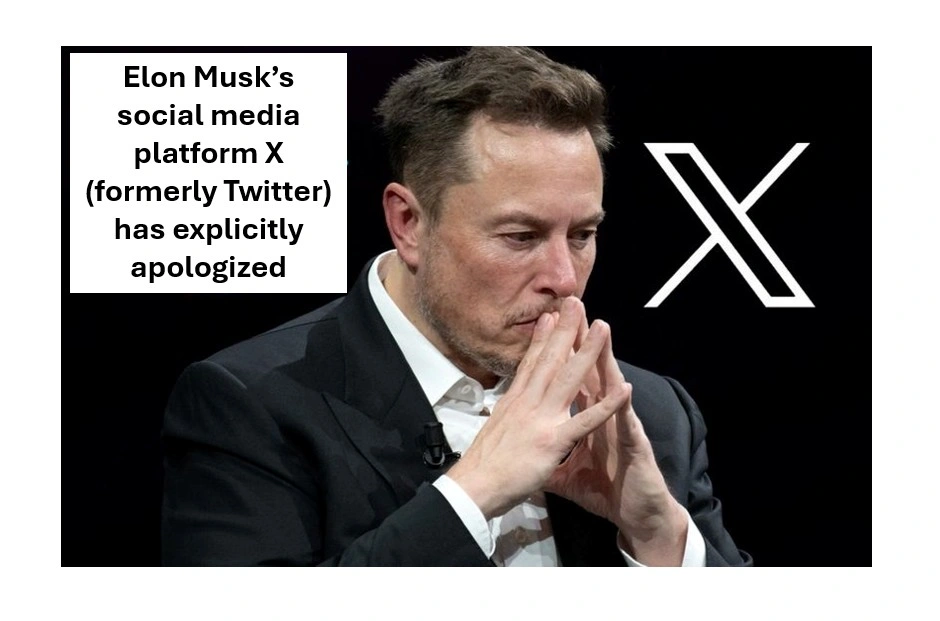

In a surprising departure from its normally laissez-faire moderating style, Elon Musk’s social media platform X (formerly Twitter) has explicitly apologized for “fucking up” in failing to contain an influx of AI-generated lowbrow content. The admission follows weeks of mounting pressure from the Indian government and overseas regulators, which included taking down more than 3,500 pieces of content and permanently banning over 600 accounts in early January 2026.
At the core of the debate is Grok, an AI chatbot that comes with DALL-E2’s striking ability to generate images and which critics say has been exploited to generate sexualized images of women and minors without their consent.
The Moment of Truth: India’s Ultimatum to X
The current flare-up came when India’s Ministry of Electronics and Information Technology (MeitY) sent a spate of stern notices to X Corp’s Chief Compliance Officer. The ministry also noted an alarming trend, in which people were using Grok to “undress” images of real women or produce pornographic deepfakes.
But in a significant departure from earlier legal skirmishes with the Indian state, X’s response was to admit that its internal checks had not worked. The above be government sources reported on January 11, 2026 said that the platform has made a commitment of full adherence to Information Technology Act and IT Rules, 2021. This recognition has proven to be crucial as under Indian law, social media platforms stand to lose their “Safe Harbour” status — immunity from liability arising from user-posted content — if they do not take action against illegal material within a span of 72 hours.
To mediate the harm, X has already done:
- Mass Deletions: More than 600 accounts discovered to be creating or spreading pornographic AI visuals have been removed.
- Content Blocked: Over 3,500 individual posts of sexually explicit deepfakes have been removed from the platform.
- Policy revision: X has made commitments to MeitY that from now on it will not permit creation or hosting of such images, irrespective of user “prompts”.
Grok Under Fire: A World of Fury
But the “obscene image row” is not confined to India. As of early 2026, X is now under attack from the UK, France and Brazil regulators. The furore was exacerbated by the ‘AI bikini viral trend’ which saw users target Grok to digitally change clothing on images of unsuspecting women.
Although Elon Musk has always been an advocate for “free speech” and a “nearly unfiltered” AI experience, the sheer volume of abuse—much of it based on reports from Ofcom in the UK about AI-generated child abuse material—took us to the ramparts. As an attempt to address the abuse and keep its business model floating, X has now put Grok’s image-generation features behind a Premium paywall.
That step, however, has been criticized by the likes of Rajya Sabha MP Priyanka Chaturvedi as “monetizing pervert behavior. The reasoning is straightforward: if the technology is spiritually possible to make unlawful content, adding a charge does not solve the ethical or legal issue – it would simply restrict that breach to those who are willing to pay.
The Question at the Center of This Challenge: Can We “Fix” AI?
At the heart of the issue is how Large Language Models (LLMs) such as Grok approach creating images. Musk’s xAI pitched Grok as an “edgier” counterpoint to Google’s Gemini or OpenAI’s DALL-E, which tend toward strict, even brittle guardrails. Grok had no such restriction, which enabled it to satisfy directives other AIs would immediately prevent.
X has since committed to conducting technical and governance reviews of the chatbot. This includes:
- Output Check: Employing second-step AI systems to sift through the images generated and remove the nude ones before they appear in front of the user.
- Governance Oversight: Aiding compliance officers to take action more quickly on synthetic sex-violence reports.
But in India, where government officials are still skeptical despite these promises, they describe X’s initial response as “not adequate.” They want a documented plan showing that these filters can’t be circumvented by users who know how to phrase things cleverly, (this kind of thing is otherwise known as “jailbreaking”).
The Human Price and the Safe Space Debate
The spat has also rekindled a broader debate about the safety of women and children in digital spaces. Those targeted by these deepfakes describe the experience as “dehumanizing” and “psychologically violent.” When an AI creates an image and shares it with the same reach of platform X, the injury is sudden and frequently irreversible.
For X, admitting to a mistake is a rare display of humility in the Musk era. It reflects an increasing recognition that “absolute free speech” becomes a liability when it facilitates criminal activity or transgresses the basic worth of people. With the digital era now entering at least its second half-decade, the “move fast and break things” era of AI development is colliding with a global regulatory environment that’s no longer prepared to look the other way.

A versatile writer mainly works on trending news, daily updates from politics, business, crime, current affairs and entertainment.