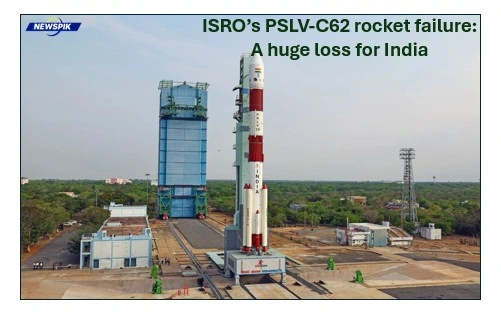

The space program of India encountered a big loss on the 12th of January, 2026, with its Polar Satellite Launch Vehicle (PSLV)-C62 mission not achieving desired outcomes by not placing its satellites in the specified orbit, resulting in the loss of 16 satellites from the mission. The Polar Satellite Launch Vehicle, traditionally known as the Indian Space Research Organisation’s “workhorse” rocket, experienced a difficulty at a critical juncture with a malfunction of its crucial third phase of flight, despite a smooth beginning of its mission objectives.
The PSLV mission that took off from the Satish Dhawan Space Centre in Sriharikota around 10:17 am IST on Saturday raised much attention across the country. The first stage, second stage, including strap-on boosters, of the PSLV rocket worked well, but “just before the PSLV was to complete its third stage, which involves boosting the velocity of the spacecraft besides guiding it towards a desired orbit, the rocket suddenly ‘encountered a disturbance’ that took it off course.”
What Went Wrong: Third-Stage Anomaly
Preliminary post-flight signals from the control room indicated that the rocket’s issues started unfolding around the end of the third stage, when telemetry either fell away or became erratic. “Disturbance in roll rates” and flight path deviation were indeed noticed as the PS3 was ending, according to ISRO Chairman Dr. V. Narayanan, thereby not allowing the rocket to inject its payloads into the intended 505 km sun-synchronous orbit.
This malfunction has eerie parallels with the previous PSLV failure in May 2025 (PSLV-C61), when a critical Earth observation satellite, EOS-09, was lost due to a drop in PS3 chamber pressure during ascent. That earlier failure was one of the only rare anomalies in PSLV’s long history, which until then had maintained an extraordinary success record since its debut in 1993. Experts and analysts are now probing whether common technical vulnerabilities are emerging in this crucial stage.
BlueBird Block-2 mission: ISRO successfully launches LVM3-M6 rocket
Payloads Lost and Partial Survivors
The main payload carried by the PSLV-C62 mission was the advanced earth observations and maritime safety satellite EOS-N1 (Anvesha) developed by India’s Defence Research and Development Organisation (DRDO) satellite. The payload was likely useful to India by improving its coastal survey and hyperspectral survey strengths. The co-passenger satellites carried by this mission were 15 satellites, including technology demonstrator satellites, University mission satellites, and cubesats from foreign nations.
Although it is officially deemed a complete failure, given that none of the bigger satellites managed to reach orbit, one of them, a small satellite, a 25 kg Spanish satellite called “KID” – short for “Kestrel Initial Demonstrator,” did manage, albeit fleetingly, to fly apart and beam its data for a few minutes before communications were lost.
ISRO Response: Investigation and Assurance However, after the setback, ISRO speedily formed a Failure Analysis Committee tasked with carrying out an investigation to ascertain the root causes of the failure and proactively develop corrective action. Despite the facts being preliminary in nature, it is reiterated by the agency that the anomaly occurred in “a highly dynamic and complex phase of the mission involving elements of solid fueled propulsion and precision guidance control.”
ISRO management has also said that this mission failure will in no way influence the schedule of other prominent programs. The most interesting thing to note is that ISRO was confident that its Gaganyaan mission to put men on Indian spaceflight is on schedule, utilizing a different launch vehicle for carrying people to space.
Indeed, at an Economic Times Roundtable recently, Minister of State in the Department of Science & Technology and Earth Sciences, Dr. Jitendra Singh casos mentioned the technical snags faced in recent PSLV missions had nothing in common and these issues will be set right before the PSLV goes back into service while briefing everyone about its successful history and ISRO’s launch cadence planning ahead for multiple missions next year.
SpaceX starts NASA’s Pandora mission to look for alien worlds far away
Impact on India’s Space Ecosystem
The implications of the failure of the PSLV-C62 are:
Commercial Confidence
The mission was marketed by NewSpace India Limited (NSIL), the commercial arm of ISRO. The loss will affect the confidence of the clients who are trying to choose the service for their satellites with India as a payload. The mission had 16 satellites onboard, including some startups and educational institutions.
Startups and Innovation
The demonstration mission for one of India’s burgeoning space startups, consisting of payloads for in-orbit re-fueling and Artificial Intelligence data processing, among others, also failed. The mission had several satellites launched by different startups, and for some startups like Dhruva Space, this mission had several satellites.
Insurance and Risk
The incident has reignited debates about insurance for space missions, particularly for commercial and startup satellite payloads. Most small businesses will not pay for insurance because they feel that, compared to the cost of equipment, insurance is too expensive. But recent events highlight one of the financial dangers for those who choose not to!
Diving into the Future with ISRO! Even as the extent of failure is alarming, space technologists believe it is an important aspect of the science of space engineering. The legacy of PSLV is a string of successes as far as the Chandrayaan, Mars Orbiter, and other satellite missions globally are concerned.
“ISRO will take time to study the reason for the anomaly, make the design changes, and then resume the flight with more confidence, even in the face of other ambitious projects like the Gaganyaan, NavIC expansion, and commercial launches.”
The high-risk game of space exploration means that failure is costly but can also prompt greater technological advances, a challenge that is being worked on within the country’s space industry.

I am a versatile content writer from the MP region, covering politics, business, crime, current affairs, entertainment, video games, and sports with clear insights, engaging analysis, and timely, reader-focused updates.