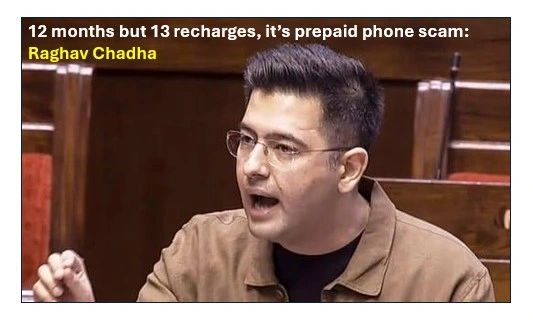

Raghav Chadha, an AAP Rajya Sabha MP, raised concerns in Parliament about a “prepaid mobile recharge scam” that affects millions of telecom users in India. Chadha raised these concerns during debate in the Upper House of Parliament, where he stated that telecom companies are offering customers a 28-day prepaid recharge plan, which means customers will have to recharge their prepaid mobile account every four weeks, or 13 times a year instead of 12.
According to Raghav Chadha, the current arrangement penalises consumers financially, and there is no consumer transparency related to this arrangement. There has been much debate about consumer rights and the billing practices of the telecom industry in India.
Raghav Chadha’s criticism relates to the fact that the majority of telecom service providers offer consumers a 28-day prepaid mobile recharge product. While the expectation is that these plans are viewed by consumers to be 12-month products, in reality, they only provide 28-days of service.
Mathematically, each user of a prepaid mobile recharge product will be required to recharge their account 13 times per year instead of 12. If you take 28 days and multiply that number by 13, you get 364 days, which is one year. However, the net result will be that consumers will make one more prepaid recharge in one year than if they only made 12 prepaid recharges.
Chadha referred to this type of activity as deceptive. He stated that telecommunication companies provide these pricing plans as “monthly” but have set up the pricing plan to create additional revenue on top of what they are charging as a “monthly” price. He referred to this form of marketing as a form of “theft” against prepaid customers and that more transparency is required in how they market these plans.
Citing Issues with Blocks on Receiving Calls
Chadha also raised another large concern with the blocking of incoming phone calls and text messages after the prepaid plan expires. Chadha commented that while the cessation of outgoing calling services after the end of a recharge is reasonable, the blockage of incoming phone calls is done arbitrarily, and serves little purpose to the consumer.
Chadha stated that people cannot receive calls or text messages, or important notifications (like a banking OTP) once a charge period is expired. This creates a significant issue for customers in emergency situations and/or those reliant on telephones to perform necessary duties.
Chadha echoed that access to mobile phone service is not a luxury anymore; it’s a necessity for people to access their bank accounts or get government services or make electronic payments. If consumers cannot receive incoming communication due to an expired recharge period, it has a significant impact on everyday life.
Impact on Millions of Prepaid Users
India boasts one of the largest telecommunications markets globally, with the vast majority of customers using prepaid services. It is estimated that far more than one billion wireless customers in India subscribe to pre-paid plans.
Because a large number of customers use this type of payment system, the impact of the 28-day billing cycle on potentially tens of millions of consumers is significant. Many critics of the country’s bills for mobile-phone service claim that in aggregate, even a small combined payment made over the course of the year would amount to a large sum of money for many of India’s mobile network operators.
For users in low-income brackets, an additional charge for recharging one’s mobile telephone may constitute an extreme burden financially. Analysts have stated that in today’s world where most people rely on mobile telephone service providers to access the internet for doing business, keeping one’s mobile telephone service active is a necessity in order to maintain connectivity.
Read more: Raghav Chadda urged to legalize digital assets in India
Chadha’s proposal for Calendar-Month-metered recharging solutions
In order to find a solution to this issue, Chadha has recommended that governmental agencies and mobile network operators give thought to the development of a metering mechanism based upon other utility providers that utilize the calendar month for billing purposes.
He stated that in today’s world, almost all forms of financial transactions that require payment and/or billing for services utilize or receive payment using the calendar month as the basis of measuring beginning and ending billing cycles (such as paychecks, rental payments, utility bill payments, loan payment schedules, etc.). As such, mobile-network provider’s billing practices should be in alignment with other utility providers to reduce confusion and eliminate additional costs that consumers would pay to use the mobile telephones services of their wireless telephone network provider.
Chadha also has advocated consumer friendly reforms and clear-cut rules so that telecom companies can provide fair and transparent billing practices to consumers.
Possible regulatory response
India’s telecom sector has been regulated by the Telecom Regulatory Authority of India (TRAI). As of now, operators must provide one plan with a 30-day validity, but that does not mean they cannot offer 28-day plans.
Involving Parliament may be a way to urge policy makers and regulators to consider modifying existing rules and providing for more robust consumer protections. It will be determined whether the government or TRAI will implement any changes, but the interest generated by the current debate surrounding the method by which consumers are required to pay for prepaid products (telecom recharge plans) suggests that some form of consumer protection is being considered.
Read also: Raghav Chadha Invites BLinkit Delivery Worker Following Low-Payment Video
Conclusion
Raghav Chadha’s presentation raises many of the same issues that have been discussed in regards to transparency and fairness in the telecom sector and consumer billing practices. Although 28-day recharge plans have been considered to be the “norm” in the industry for a long time, there is a substantial amount of criticism of using these plans because consumers effectively make two annual recharges per year as a result of having to pay for 28-day products due to their frequency.

I am a versatile content writer from the MP region, covering politics, business, crime, current affairs, entertainment, video games, and sports with clear insights, engaging analysis, and timely, reader-focused updates.