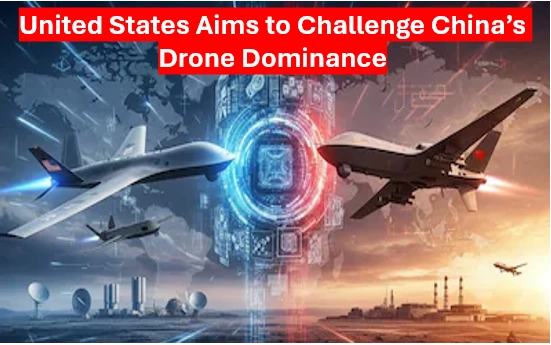

The US is trying to break China’s huge lead in drone production, but it is having a hard time because of structural, economic, and supply-chain problems.
Why do you think that?
Reason 1: The Difference Between Size and Cost
Officially, the Pentagon has started big projects like the $1.1-billion “Drone Dominance” effort, but China still makes about 90% of all business drones.
According to the Wall Street Journal and other news sources, the main problem is not technical skill but rather industrial scale. Most drones are pretty easy to put together, but China’s huge production ecosystem lets them make them for a lot less than American companies.
Military quadcopters made in the US can cost more than $15,000, which is at least three times the price of a similar drone made in China.
The war in Ukraine has shown how important “sacrificial” mass is; every month, they kill about 10,000 drones. Right now, it’s hard for U.S. industry to keep up with that level of supply at a price that can be sustained.
Reason 2: The “Stranglehold” of the Supply Chain
China is still the best place to get important drone parts like motors, sensors, and rare earth magnets.
Beijing put Skydio on a watchlist in late 2024 because it sold drones to Taiwan. Skydio is the biggest drone maker in the US. Because it couldn’t get batteries from China, the business had to limit the number of cells it could sell. This shows how Beijing can “weaponise” its control over the supply chain to slow down Western rivals.
When new US rules go into effect on January 1, 2027, they will ban rare earth materials from China from being used in US weapons. This will almost immediately force defence companies to find local options for magnets and motors.
Read also: Spirit Airlines ‘winds down’ service; US airlines help stranded passengers and workers
What do the US does?
To deal with these problems, the US is changing how it buys things:
Pete Hegseth, the Defence Secretary, recently started a plan to lower costs by promising huge, long-term buy orders from U.S. suppliers to boost investment in the U.S.The FCC has banned drones made in other countries starting in 2027 so that American companies can have “white space” to grow.
It was reported that the next part of the Replicator project will focus on anti-drone defence systems. This is because the U.S. needs to be ready for a “onslaught” of Chinese drones in case of a war.
Read also: Iran attacks a hotel in Dubai
The key players in the US
There are claims that as the US tries to “break” the power, a number of US companies are growing to fill the gap:
Focusing on self-inspection and government flying, Skydio is based in San Mateo, California.
AeroVironment (Arlington, VA) has been making military drones for a long time.
Anduril and Shield AI are two companies that are making devices that use AI and a lot of software.
Analysts say that if a war happens before 2027, the U.S. may have to make a “tough choice”: follow strict rules for domestic buying and run out of tools, or break the rules and buy from the Chinese supply lines that the U.S. is trying to avoid.
Frequently Asked Questions
Why does China have so many drones?
China is the leader because it can make a lot of drones at low cost and has strong supply lines. Companies like DJI control a big part of the world’s consumer and business drones.
Is it easy for the US to catch up?
Not quickly. The US has great defence and software skills, but it has problems with cost, mass output, and being dependent on batteries and the supply chain.
What is the US doing to stay ahead?
The US wants to make more drones in the US, limit the use of Chinese drones by the government, and invest in military-grade and AI-enabled drone tech. It won’t take months, though; it will take years to replace China’s world environment.

A versatile writer mainly works on trending news, daily updates from politics, business, crime, current affairs and entertainment.









