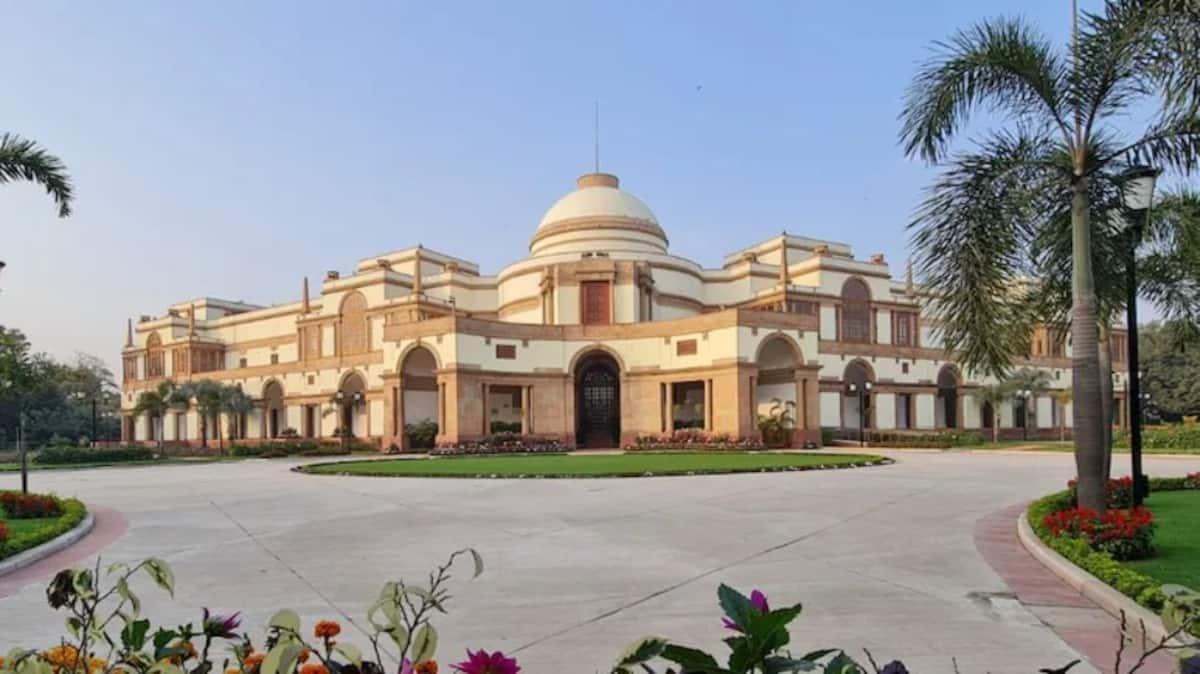

The famous Hyderabad House at 1 Ashok Road in the city will be the site of talks, dinners, and other official events with Russian President Vladimir Putin. The building has a long history and was made by the world’s richest person. Its towers, halls, stairs and gardens were built to impress a kingdom, but now they are used to make choices that affect everything in the world.
Before world leaders walked through its dome-topped rooms, Mir Osman Ali Khan, the last Nizam of Hyderabad, ruled over a country that was so rich that stories said he had enough pearls to fill whole swimming pools and mansions that were spread out across what used to be Deccan like gems.When the British moved India’s capital from Calcutta to Delhi, the Nizam tried to make a name for himself in the new city that fit with his fame.
An Ask That Shocked The British Government
The royal states wanted to sign the imperial map while the plan of the new city was being finalised. Because they were interested, the Viceroy was happy. He saw their appearance as a sign of loyalty to the new city. But Khan had a request that the British thought was too much. He wanted a nice plot of land in Princes’ Park, close to the Viceroy’s House.The imperial government didn’t like how close it was, so only five royal states were given land three miles away, around the figure of King George V. Some of these cities were Jaipur, Bikaner, Baroda, Patiala, and Hyderabad.
The Nizam of Hyderabad and the Gaekwad of Baroda were the only ones of these five to hire the famous builder Edwin Lutyens to create their homes in Delhi.
The Nizam hoped that Lutyens would build a house as grand as the Viceroy’s House. He was given a 21-gun salute and had an “exalted” standing in British India that had never been seen before. The British refused to equalise, so the government required all royal houses to obtain official approval for their designs.
So, Lutyens only used one architectural feature from the Viceroy’s House—a centre dome—, but he gave the Nizam a home that was unlike any other in Delhi.
The Beginning of a Palace Shaped Like a Butterfly
The Hyderabad House was built in the shape of a butterfly, with its wings opening up along the roads around it and its door lined up with the approach road on the hexagon. Lutyens took this plan from Papillon Hall in Leicestershire, which he built in 1903. The end result was a home that immediately stood out from all the other royal palaces in the city.
It was built for an amazing 200,000 pounds in the 1920s, which is about 1.4 million pounds or Rs 170 crore today. The house was a perfect reflection of the Nizam’s huge wealth. He was the richest person in the world at the time. The Hyderabad House had an impact that few other buildings in Delhi could match, even though it wasn’t as big as the Viceroy’s House.
36 rooms, a musical piece of architecture
There are gardens, arches, stairs, fires, and ponds in the Hyderabad House, which has 36 rooms. A bit of Mughal style is mixed in with the European style.
Because Lutyens was known for making big public buildings, he made sure that the Hyderabad House stuck out from the Jaipur House and the Patiala House that were next door.
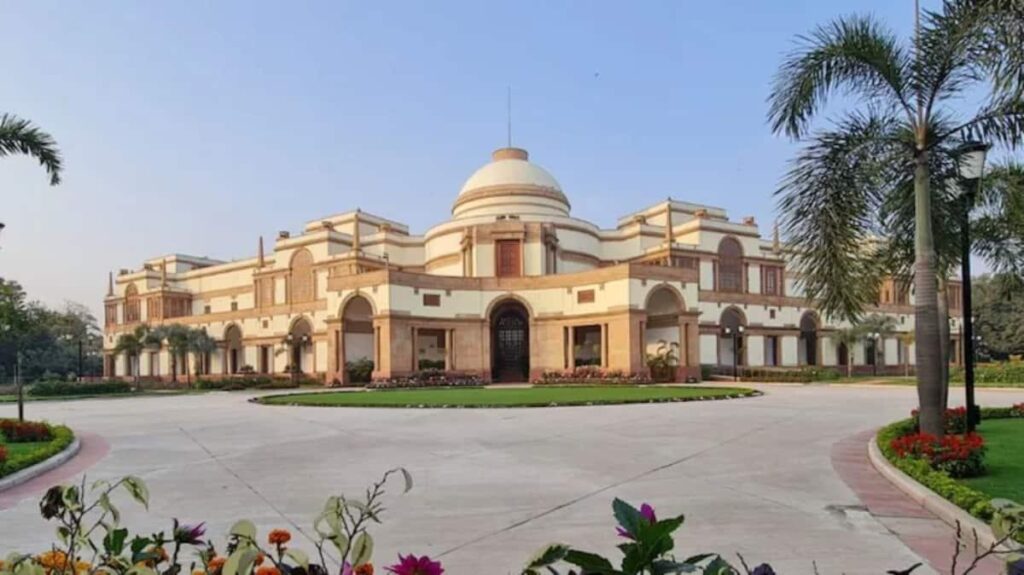
The main feature of the building is a large dome that rises above an entrance hall and has identical sides that extend at exact 55-degree angles. The house is on 8.2 acres and is close to the India Gate.
The circular lobby and the hallway on the first floor have beautiful rhombic marble floor designs.
The round domes and rectangular holes that go up to the height of the impost were a design idea Lutyens got from his time spent in 1909 in Rome at the Pantheon.
The windows on the first floor, which have both square and round openings, were modelled after the view from the Uffizi Gallery over the Arno in Florence. The zenankhana, or “women’s section,” was one of the most interesting parts of the palace. It was a circular court with 12 to 15 rooms. There is a famous quote by Lord Hardinge that says each room was “the size of an ordinary horsebox with only one window close to the roof.” He talked about a row of tiled bathrooms that only had hot and cold water taps. The water flowed straight onto the women because “there seemed to be no way to mix the hot and cold water, as it pours on to the ladies,” he said.
A Pearl In the Imperial Setting of Delhi
The Hyderabad House was the most beautiful royal house in New Delhi between 1921 and 1931.Only the Viceroy’s House was more beautiful. Its design was meant to amaze, make a point, and maybe even make people a little envious as they walked by.The Nizam’s diamond mines, which included the famous Jacob Diamond, paid for the building. The house became a sign of his independence and loyalty to the British Raj. Interestingly, Khan himself only went very rarely, even though it was very beautiful.
A Change in the Plan After 1947
The future of the Hyderabad House changed a lot after India got its freedom. The royal states were being merged into the Indian Union. Hyderabad, which had a Muslim ruler ruling over a mostly Hindu people, fought against the union until Operation Polo in September 1948. Late
Over the next few years, the Nizam’s family didn’t use the Hyderabad House very often.
The government probably got control of the land through a gift or sale, but full records were never made public. As India’s foreign needs grew in the early 1970s, the palace was fully taken over by the central government. The Ministry of External Affairs took over in 1974 and changed it so that it would be used for state dinners and public events.
The India Tourism Development Corporation (ITDC) took care of the palace’s cleaning and held events that met international standards. This gave the palace a new political life.
From a royal home to a government office
Over the years, the Hyderabad House has become the main place where the prime minister hosts state guests. Its doors have been opened by presidents, prime ministers, kings, and other important people from around the world. A lot of foreign ministers and people who make decisions about world policy, including Bill Clinton, George W. Bush, Gordon Brown, and Vladimir Putin, have come to important state events here.
Its position in the middle of everything, closeness to important offices, and ability to hold the most private VVIP talks made it an important part of India’s changing foreign policy.

I craft sharp movie reviews and trend analysis, known for deep research, clear insights, and compelling storytelling across the latest in film and pop culture.