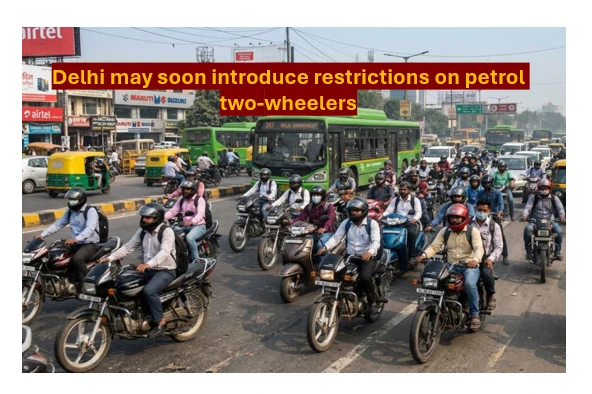

New petrol two-wheeler registrations may soon stop in Delhi, which is causing worry among riders because it could mean a big change in how people commute, which could affect millions of people who depend on bikes and scooters every day.
With the draft EV Policy 2.0 from the Delhi government, there is a plan to stop new registrations of two-wheelers that run on petrol, diesel, or CNG from August 15, 2026. This is to encourage more people to buy electric cars (EVs) and reduce pollution.
The Delhi government has released the draft Electric Vehicle (EV) Policy 2026–2030. It lays out a detailed plan to speed up the capital’s transition to electric mobility by putting time limits on petrol vehicles, making fleet rules stricter, offering incentives for people to switch to EVs and building a lot more charging stations.
The draft was made public by the Transport Department’s EV Cell so that people and experts could give their opinions for 30 days before it was finalised. The policy’s goal is to cut down on vehicle emissions, which are still a big part of Delhi’s air pollution problem, especially during winter smog events.
This policy is being thought about right now, and the Delhi government might approve it this week. The government will no longer permit new registrations of two wheelers driven by petrol or CNG starting on August 15, 2026, according to the news service PTI.
Experts think that EV two wheelers will soon rule the roads in Delhi if this plan is put into action.
Plan 2.0 for EVs
As of August 15, 2026, the Delhi government has said that only electric two-wheelers will be able to be registered in Delhi. We will not be able to register any new petrol-powered two-wheelers bought after this date in Delhi.
Fixed phase-out dates are set for gasoline two-wheelers and cars.
One of the most important ideas in the plan is that it sets clear limits for electrifying certain types of vehicles.
Beginning January 1, 2027, new registrations in Delhi will only be possible for electric three-wheelers. After this, from April 1, 2028, only electric two-wheelers will be allowed, marking the end of the old system.
There are also new rules for business cars that come with the program. From January 1, 2026, no new cars with internal combustion engines will be able to work with aggregators. This includes two-wheelers and light goods trucks that weigh up to 3.5 tonnes. BS-VI two-wheelers that are already in these companies will only be allowed until December 31, 2026.
Both school buses and government buses will soon follow
The plan makes it a goal for all school travel systems to be powered by electricity. Electricity will be added to school buses over time. The goal is for 10% of buses to be electric in Year 2, 20% in Year 3, and 30% by 2030.
Read also: Fines and exemptions for new UP transport laws beginning April 16
Tax breaks, incentives, and the push to get rid of things
Electric two-wheelers that cost up to Rs 2.25 lakh will get subsidies based on the size of their batteries. The rebates will be bigger in the first year and lessen each year after that. Electric three wheelers and goods vehicles will also get incentives that decrease over time. Electric cars, on the other hand, will be able to get incentives of up to Rs 1 lakh under certain situations.
The policy also offers scrappage rewards between Rs 10,000 and Rs 1 lakh, based on the type of vehicle. These are meant to encourage people to replace their older BS-IV and lower cars with newer ones. You will be able to get these benefits if you have a legal scrap license and meet certain deadlines.
DTL will be in charge of expanding the charging network
A big part of the strategy is to quickly add more charging stations for electric vehicles all over Delhi.
Delhi Transco Limited has been named as the main organization in charge of planning, putting the charging and battery swapping network into action, and connecting it to the power grid.
EPR, recycling batteries, and the push for a circular economy
A lot of weight is put on efficient energy management in the strategy.
Extended Producer Responsibility (EPR) rules, battery collection systems, recycling guidelines, and safe dumping methods will all be put into place by the Delhi Pollution Control Committee.
To make sure that widespread use of electric vehicles doesn’t cause a trash problem at the same time, a battery tracking system is also being considered. This would allow batteries to be reused and put to use in other ways.
Read also: Govt Eases Kerosene Rules Amid Energy Crisis, Petrol Pumps Allowed to Sell Fuel
Rules for OEMs, the digital system, and the EV fund
Original Equipment Manufacturers (OEMs) will have to make sure there are enough EVs on the market and set up charging infrastructure at stores. This will include a minimum number of charging spots for each type of car.
All parts of the system—applications, approvals, support payments through Direct Benefit Transfer (DBT), and complaints—will be fully digital and paperless.
To pay for implementation, a special EV Fund will be set up. This Fund will be backed by state budgets, central government programs like PM E-DRIVE, environmental fees, and other approved sources.

A versatile writer mainly works on trending news, daily updates from politics, business, crime, current affairs and entertainment.









