The United Arab Emirates is known as one of the most opulent places in the world, with its tall buildings, supercars, and lavish way of life. The country is also economically strong, despite its image of wealth and luxury. It has a GDP of $504 billion and a population of only 9.52 million people. Its strong banking infrastructure, high per head income, and low unemployment make it one of the world’s most safe economies. Even though the UAE is doing well, one of its biggest problems is that it doesn’t have enough fresh water.
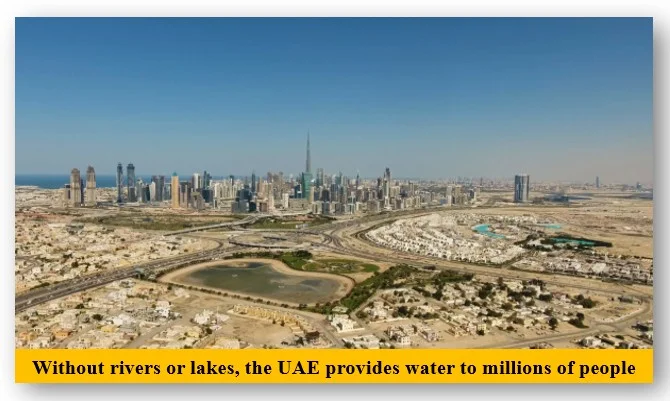
The country is in the dry Arabian Peninsula desert and doesn’t have any natural lakes or rivers. Because it doesn’t rain much and evaporates quickly, it depends on rainwater from the Hajar Mountains to fill up seasonal wadis and underground canyons. Natural sources used to provide all of our water needs, but now most of it comes from desalination. This is because climate change, more people living in cities, and over-using groundwater are all putting more stress on this important resource.
Where does the UAE get its water?
1. Desalination: Using saltwater as a source of water
Almost 70 large desalination plants are running in the UAE, meeting 42% of the country’s water needs, according to the State of Energy Report 2015. The UAE is one of the top makers of desalinated water because these sites make up 14% of the world’s total output. This process removes salt from water using Reverse Osmosis (RO), Multiple-Effect Distillation (MED), and Multiple-Stage Flash (MSF).
Demand for water rose by 35.8% between 2008 and 2012, making the need for long-term purification even greater. To meet its long-term goals, the UAE is now actively looking into purification systems that use sustainable energy.
2. Groundwater is an old supply that isn’t very plentiful
Some areas still use old aquifers, which are deep water stores. It’s too easy to take too much of these, though, so they can’t be a lasting answer.
3.Treated wastewater: recycling for a greener future
The UAE has come a long way in reusing wastewater. This helps save important groundwater by reusing treated water for things like watering, gardening, and commercial uses. The goal for the whole country is to safely use 95% of all cleaned wastewater again.
4. Keeping water and bringing it in
To make sure there is water even during emergencies, the UAE has put a lot of money into big lakes and emergency storage tanks. A lot of people don’t know this, but officials have said they are looking into importing water from nearby areas to make the supply more reliable.
What About the Dunes? Another smart move
The UAE doesn’t have any stable rivers, but it does have wadis, which are seasonal valleys or dry riverbeds that come to life when it rains hard and rarely. A lot of this rain falls on the steep sides of the Hajar Mountains and runs off to gather in the wadi beds. Here, water creates brief pools and streams, especially in places like Wadi Wurayah that have springs below the ground. The water also seeps into limestone and gravel aquifers to fill up underground water tanks.
These deep stores are very important for farming and other human activities. Wadis are useful for many reasons, but they are also important for wildlife and ecotourism. For example, Ras Al Khaimah’s Wadi Shawka is famous for its stunning natural beauty and popular hiking trails. People who live in a country with dry areas depend on these seasonal waterways to keep life going and make a living.
UAE Water Security Strategy 2036: Making Plans for the Future
To make sure it will last for a long time, the UAE launched the Water Security Strategy 2036, which was made with feedback from all the important people in charge of managing water in the country. The approach sets big goals, such as
- Total water demand drops by 21%
- Raise the measure of water production to 110 USD per cubic meter.
- Lower the measure of water shortage by three degrees.
- Using 95% of clean wastewater again
- Increase the country’s ability to store water.
- Make sure everyone can get safe drinking water at a price they can pay.
- This plan fits with the National Water and Energy Demand Management Program’s goal of making the transportation, industry, and building sectors 40% more efficient.
Innovation in times of lack
The UAE’s ability to manage water well, even though it is naturally scarce, shows how forward-thinking its government is and how good its engineers are. Climate change and population growth are putting the world’s water sources at risk. Other dry countries can learn a lot from the UAE’s example.
It may seem strange, but a country with no natural rivers has become a star in water protection and making cities more sustainable. The story of the UAE isn’t just about how they did well in the desert; it’s also about how creativity and a clear vision can turn weakness into strength.

I am a versatile content writer from the MP region, covering politics, business, crime, current affairs, entertainment, video games, and sports with clear insights, engaging analysis, and timely, reader-focused updates.