
At a tiny study room in Old Rajinder Nagar, Delhi, 24-year-old Ananya spends her time in piles of Laxmikanth and NCERT textbooks. She possesses a Master degree in Economics with an amazing 8.5 CGPA. However, in the past two years, her office has been a wooden table in a small 10 x10 room that she rents, and the salary has been her monthly allowance sent by her father in their village in Bihar.
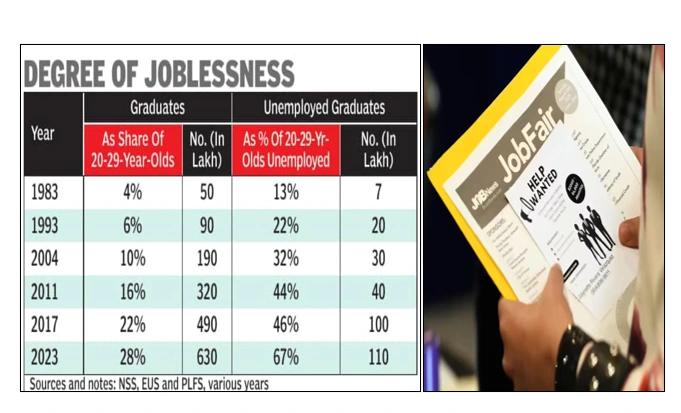
Ananya is not an anomaly. She is the face of a shocking statistic that was recently reported in the State of Working India 2026 report by Azim Premji University and recent labour statistics: about 67 percent of the unemployed young population in India is now a graduate. In a nation whereby a degree used to be a sure pass to the middle class, it has since been met to represent an excruciatingly long wait.
The Irony of the educated unemployed
The Indian dream was constructed on one premise, which was to study hard, achieve a degree, and the world will open its doors. Today, that door is jammed. The recent developments indicate that even though the overall unemployment level has been seen to stabilize at approximately 4.7 per cent as of end 2025, the responsibility of unemployment has been very skewed towards the highly educated.
The report shows a ghastly outreach: close to forty percent of graduates below the age of 25 cannot get employment. The rate decreases to 20% as the age group rises to 2529 and this implies that although the graduates eventually have something to occupy their time, the period between the classroom and the cubicle is rife with suffering and frustration.
It is some weird form of mourning, Ananya follows the borders of her degree certificate. You spend fifteen years hearing yourself saying how you are the future of the country because you are educated. You then go into the market and know that what you have is a redundant product that no one will want to purchase.
Why a Degree No Longer Sells a Desk?
The crisis is based on a skills-jobs mismatch which has culminated in 2026. As it was mentioned in the Economic Survey 2024-25, only 8.25% of the graduates work in the positions that, in fact, correspond to their qualifications. The rest? They are the overqualified delivery partners, data entry operators or the always-aspirants that are trapped in the loop of competitive exams.
A number of structural elements have come to form this bottleneck:
- The Degree Factory vs. Skill Gap: Over the past 10 years, India has experienced 300 percent increase in the number of vocational and technical institutes, but industry players argue that less than 80 percent of recruiters have difficulties in finding job ready candidates. The curriculum is stuck in the 20th-century troll learning, whereas in 2026 market, people will need to be fluent in AI teamwork, data analysis, and adaptability in solving problems.
- The Paper Shield is Thin: In most of the developed economies, a degree is an extra that protects against unemployment. It has turned into a weakness in India. Statistics indicate that the unemployment rate is below zero among the uneducated or those with no formal education- merely because they cannot afford to remain unemployed and go on to accept any manual labor that arises. Graduates but still, they have reservation wages and social requirements which make them wait till they get decent jobs.
- The Government Job Trap: Millions of young graduates spend the most productive years of their lives (22 years to 30 years old) chasing the few government vacancies. This is this type of bhed-chaal (herd mentality): an enormous drain on human capital in the form of the current viral tales of post-graduates seeking peon jobs just to gain some form of stability.
Read also: UPSC updates rules on re-attempts for serving candidates
Human Cost of Waiting Room
Cloaked behind the 67 percent is a tally of millions of personal experiences of self-esteem loss and family strife. There has also been an alarming trend in the past two years, where the proportion of young men in education has dropped from 38% to 34%. The reason? There is no way that families can afford to keep their children in classrooms which do not lead to kitchens. More than 72 percent of the dropouts gave the pressing need to provide for household income.
The story is even more intricate as it applies to women. Although the gap between the earnings of both genders in graduation has been reduced, the unemployment rate of female youths is very high compared to males. Most women have been overeducated to occupy the household positions that society demands of them, but they lack the support of an infrastructure that allows them to commute and take care of their children as luxuries in the city.
Read also: 19 year old student argues in Supreme Court for his MBBS seat

A versatile writer mainly works on trending news, daily updates from politics, business, crime, current affairs and entertainment.