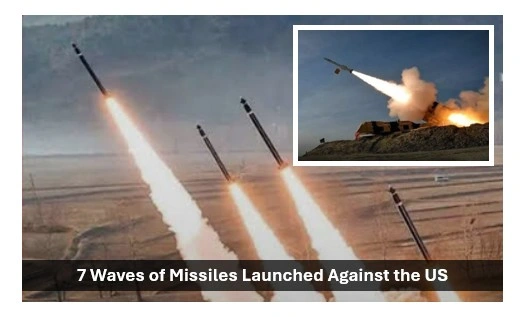

The United States was the target of seven organized missile waves over ten hours in one of the largest and longest military aggressions ever recorded in history.
The attacks were planned by Defense officials to target a variety of military facilities, infrastructure, and early warning systems, making the attacks highly organized and sequenced.
Timeline:
The first wave of attack began just after midnight; states reacted quickly to these attacks. Each of the following waves had a 60-120 minute time interval between them, allowing maximum cooperation for all states involved to make it difficult to establish an effective defense against the attacks. After the seventh wave had occurred, emergency response systems across the United States were functioning at an all-time high and nationwide airspace restrictions were put into effect.
Military analysts believe the staggered timing of the waves allowed the attackers time to assess damage caused by earlier waves so that adjustments could be made to the targeting so that maximum damage could potentially be achieved. Concerns regarding the level of advanced surveillance utilized and the degree of real-time coordination capabilities used by the attackers have also been raised given the nature of the assault.
Defense Systems and Response
The United States deployed its multi-tiered missile defence network that includes both land-based interceptors and regional defences capable of addressing both short- and long-range threats. Although officials confirmed some successful interceptions of incoming missiles, there were a number of missiles that penetrated the U.S. defences and caused localized damage.
DOD officials have reported that “rapid and effective” response protocols were implemented; however, they also acknowledged that the scale of the attack tested existing response protocols more than had ever been previously experienced. Additional assets from the military, including fighter wings and naval defence units, were deployed as a precaution.
Read also: US-Israel attacked Iran’s nuclear facility
Impact to Infrastructure and Civilians
Initial reports indicate that the transportation systems, energy production assets and communication infrastructures suffered extensive damage in various areas of the country. Emergency responders have been dispatched to several locations and evacuations of those residents in high-risk areas have been ordered by authorities. Casualty counts have not been released but officials have noted that early warning systems were instrumental in minimising the loss of life.
Major metropolitan areas experienced intermittent outages of electricity and disruptions to local public services. Federal and state agencies are working together to restore essential functions and to assess the full extent of the impacts.
Read more: US F-35 stealth fighter jet damaged by Iran
Global Reactions and Strategic Concerns
World leaders reacted quickly, calling for restraint and immediate diplomatic engagement. An emergency meeting of the United Nations (UN) was held to discuss the possibility that this could lead to a wider conflict as it continues to develop.
Security analysts are focused on identifying what the source of the attack is. No group or country has yet taken responsibility; thus, multiple avenues of investigation are currently underway by intelligence organizations, including state-sponsored activities and multiple non-state actors working in concert with one another.
As investigations progress, it has been reported that the U.S. Government raised its national threat level and is reviewing both defensive and offensive responses. Cybersecurity measures have also been increased given the possibility of digital attacks being launched before or immediately after the missile strikes.
The research on the attack indicates new threats presented by modern-day warfare. The future will be determined by the speed at which new threats are developing, the level of coordination between the actors involved, and the high-tech nature of warfare today. The next few days are going to be crucial with respect to establishing who is responsible and how the global community will respond.

I am a versatile content writer from the MP region, covering politics, business, crime, current affairs, entertainment, video games, and sports with clear insights, engaging analysis, and timely, reader-focused updates.









