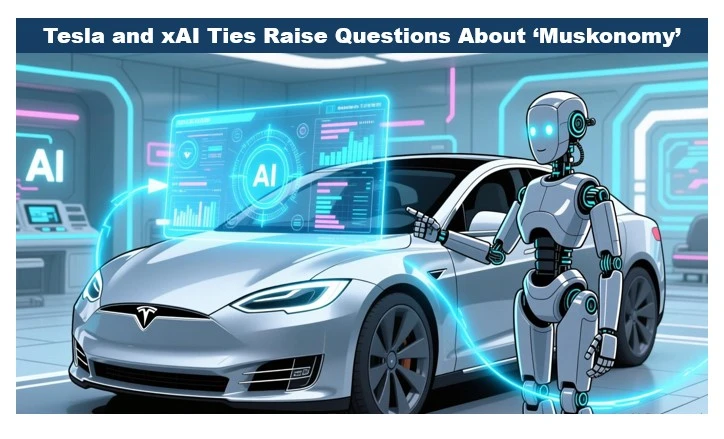

In the high-stakes world of Silicon Valley, line drawing between a CEO’s different ventures is common. But for Elon Musk, those lines are growing fuzzy. It’s often called the Muskonomy, an eccentric and controversial ecosystem in which Tesla, SpaceX, xAI (his effort to create a brain-bot interface) and X (which was once Twitter), along with his other companies, function as cogs in an interconnected machine. While this confluence suggests that synergy of an unprecedented scale lies ahead, it has also sparked a storm of controversy as to corporate governance, fiduciary duty and what really is the future for Tesla as a leader in AI.
The Public Capital-Private Ambition Intersection
The latest confrontation revolves around growing ties between the publicly traded Tesla and Musk’s private artificial intelligence startup, xAI. The talk on the street in 2025 and early 2026 moved from theoretical synergy to cold, hard cash. Musk publicly mused about having Tesla cough up $5 billion to buy into the xAI—something that was roundly rejected by institutional investors and corporate governance enforcers, but a gesture embraced by the retail crowd.
Though a nonbinding shareholder vote in late 2025 registered solid majority support for the investment, it technically failed by that date because so many of shareholders abstained. Still, the board — which is chaired by Robyn Denholm — said it would “examine next steps,” meaning that hopes for a formal financial tie-up are far from extinguished.
Elon Musk’s ‘Space Based AI’ Revolution Is A Threat India Must Prepare
Strategic Fit or Conflict of Interests
Defenders of the Muskonomy will tell you that xAI is the “brain” Tesla needs to realize its two main moonshot goals: FSD (Full Self-Driving) and Optimus, the humanoid robot. By combining talent and computing resources, the theory goes, all of Musk’s companies can innovate more quickly than traditional siloed corporations.
But critics have characterized the company’s financing as a “shell game” in which resources are shuffled around to benefit Musk’s personal control. And several key controversies have fanned the flame:
- The GPU Redirection: In 2024 thousands of high-end Nvidia H100 chips that were first commissioned for Tesla were turned over to xAI. Musk defended it, arguing that Tesla lacked the infrastructure in place to shield a public company’s resources from a private one, but the optic of money flowing out of one firm and into another was provoking some stinging questions.
- Talent Drain: There are rumors that high level AI talent is walking out of Tesla to join xAI, with one source accused Tesla’s ONDM team being “hollowed out” to populate Musk’s private organization.
- The Optimus “Brain”: Although Tesla does touch the hardware component of the Optimus robot, it appears that xAI may be the one to develop its software intelligence. This begs the ultimate question: if xAI owns the “intelligence,” then isn’t Tesla just a low-margin hardware supplier?
The Legal and Financial Stakes
The stakes of the Muskonomy are not purely theoretical; they are counted in trillions of dollars. Tesla is valued largely based on its stature as an A.I. and robotics powerhouse, not just a car company. If xAI is the fountainhead of “intellectual crown jewels,” Tesla’s stratospheric valuation may come a cropper.
The legal system is also catching up. Shareholder lawsuits have been filed in Delaware Court of Chancery, alleging breach of fiduciary duty. They maintain that Musk has “a conflict of interest” in starting a separate AI company outside of Tesla after asserting before that Tesla was in fact an AI company. These suits are asking that Musk’s interest in xAI be transferred to Tesla, or failing that, a distinction be drawn with the material support of business resources.
Conclusion: A High-Risk, High-Reward Bet
First of all, the Muskonomy is a radical experiment in contemporary capitalism. It treats distinct corporations as a single strike force assembled to “comprehend the universe” and “advance sustainable energy.” For the dedicated “Tesla bulls,” this entangledness is a feature, not a bug—a means of ensuring that Musk maintains every reason to take Tesla to a multi-trillion dollar future.
For others, it’s a failure of traditional corporate buffers. As the board mulls its next investment moves and the courts weigh investor lawsuits, one question hangs in the air: Can one man serve so many masters without some shareholders being left behind?

A versatile writer mainly works on trending news, daily updates from politics, business, crime, current affairs and entertainment.