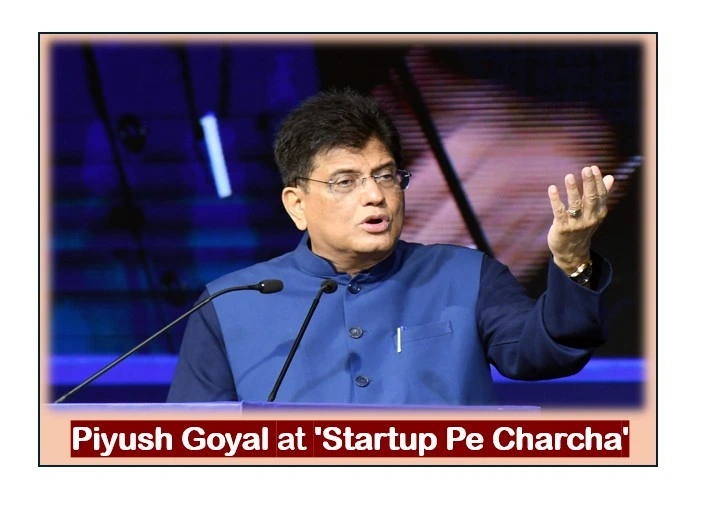

In the fast-flowing stream of global geopolitics, India is settling into a niche that has as much to do with home-grown resilience as it does with cross-border integration. I envision an India that is fully self-reliant and also well integrated with the world: Piyush Goyal Hyperlocal news was recently in conversation with Union Minister of Commerce and Industry, Piyush Goyal at ‘Startup Pe Charcha‘ interaction event held at Bharat Mandapam.
A basic tenet of this strategy, is centred around two essential fulcrums: FTAs that open doors globally and an incessant focus on EoDB which ease the path for entrepreneurs domestically. These are not merely administrative checkboxes, they’re the engines driving what makes India a “globally trusted economy,” Goyal said.
Free Trade Agreements : More than Just Lowering of Tariffs
For many years, FTAs were typically seen through a narrow prism of import-export balances. But the “new-age” treaties India has concluded (of which UK, UAE and EFTA are the leading examples) represent a substantial departure.
As Minister Goyal pointed out, we have a stable and predictable framework for investors thanks to these pacts.” By doing away with non-tariff barriers and establishing a “rules-based” trading environment (which New Delhi has simultaneously been exploring with other partners), India is making one thing clear: it can be counted on in a world where supply chains are being increasingly weaponized for geopolitical gain.
- Market Access : New set of agreements will provide unprecedented market access to Indian MSMEs and start ups in advanced markets like in services, digital payments & clean tech.
- Investment Commitments: The India-EFTA Trade and Economic Partnership Agreement (TEPA) for example comes with a big ticket investment commitment of US $ 100 billion in FDI over the next 15 years, creating one million direct jobs.
- Strategic Security: They ensure that the Indian economy is not vulnerable to “supply chain weaponization,” instead expanding the scope of trade partners and securing critical mineral transit routes.
The Regulatory Revolt: Making Business ”Easy”
If FTAs serve as the external bridge, then the internal foundation is being remade on a much more modest scale — by way of substantive cuts in regulation. Speaking on this, the Minister Goyal said “The decisive reforms of 2025 have given a new life to India’s startup ecosystem.”
The figures go a long way to creating an argument for decriminalization as well as simplification. The government has reportedly slashed more than 42,000 compliances and decriminalized almost 200 offences under the central acts. This is not just about time savings — it’s about shifting the culture from one of “permission” to one of “partnership.”
Key Drivers of Domestic Confidence:
- Jan Vishwas Act:The government has dampened the “fear factor” for small business houses by making criminal penalties minor and with only a civil fine to be paid.
- GST Rationalization: A simplified GST regime in sectors such as textiles or handicraft has made it easier for the local artisan to get into formal economy.
- Repeal of ‘Angel Tax’: With the abolishment of this tax, from 2025-26, a big barrier to early stage capital has been removed. It will help Indian startups compete for funding without any disadvantage worldwide.
Seeking Jobs, and Creating Them: A Cultural Shift
The most, well, human part of the Goyal speech was his emphasis on growing self-confidence among Indian youth. He observed a distinct shift from the “play-it-safe” mentality of past generations. Indian youths today are more daring than their parents, a change propelled in part by the backing of their government and a digital grid that is often the envy of wealthier countries.
With more than 115 unicorns, and a start-up ecosystem expected to contribute $1 trillion to the economy by 2030, India is no longer just an outsourcing destination; it’s an entrepreneurial hotbed.
“A resurgence in India, what is the biggest change there? Gone are the days of settling for safer career choices; they want to create, try and lead.” — Piyush Goyal
The Road to ‘Viksit Bharat’ 2047
As per the Commerce Minister’s articulation, that ultimate aim was Viksit Bharat @2047—a developed India by its 100th year of freedom. This vision needs the country’s mantle as the fastest-growing large economy to work with growth that is inclusive.
By linking PLI schemes with global trade deals, India is ensuring that its production expansion is underpinned by foreign demand. The synergy of ‘Make in India’ for the world and ‘Ease of Doing Business’ for a citizen is best summed up by a culture of trust, investment, growth.
As the world order continues to shift, India’s brand of strategic autonomy and economic openness offers a template for resilience. It’s an economy that not only demands a seat at the table —it is building the table.
PM Modi to interact with young leaders at Viksit Bharat Dialogue Finale

A versatile writer mainly works on trending news, daily updates from politics, business, crime, current affairs and entertainment.