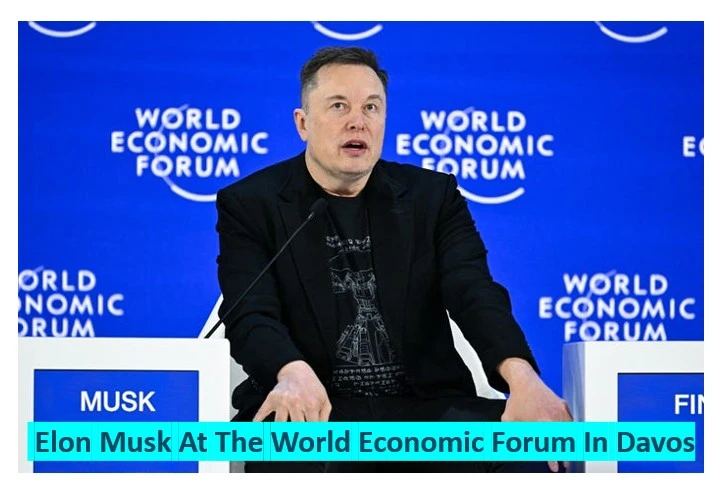

For years, the conversation between Elon Musk and the World Economic Forum (WEF) was a game of digital grenades tossed from across the pond. Musk had famously ridiculed the annual schmoozefest in the Swiss Alps as “boring AF” and asked if the “unelected world government” was trying to be the “boss of Earth.”
But then on Thursday, Jan. 22, 2026, the story veered into a shocking new direction. And in a last-minute addition that caused a stir at the Congress Center, the world’s richest man finally made his way to the Davos stage — for the very first time. Taking to the stage less than 24 hours after his political compatriot, President Donald Trump, spoke at the same forum, Musk took a seat for an open dialogue with BlackRock CEO and WEF interim co-chair Larry Fink.
What came next was not the hostile takeover some critics had feared, but a freewheeling, occasionally giggly and deeply visionary conversation that wound its way from the survival of consciousness to the inevitable ascendancy of our future robot neighbors.
A Thaw in the Alps: Why Now?
The million-dollar question: What had changed? For years, Musk had been an ultimate outsider — a critic of the “global elite” who also happened to be running companies that have become inescapably part of the discourse and infrastructure of planet Earth.
Insiders tell me that his participation is a “pragmatic recalibration.” Increased Musk power — including his help with the Trump Administration’s revamp of government efficiency and massive investments into AI and space rockets — made the billionaire too influentiaal to ignore at Davos.
It wasn’t long before Musk cut the tension with his own brand of dark humor. As Fink encouraged Musk to talk about SpaceX and the fate of humanity, Musk returned to his longtime goal of colonizing Mars.
The gag became the springboard for a serious philosophical discussion. Musk talked about the “fragility of consciousness,” saying that human life was like a “little candle in a much, much larger darkness.” That is what motivates his case for a multi-planetary life, he said: not escaping Earth, but insuring that the “light of consciousness” doesn’t blink out from one bad day.
The Robot Revolution: A Post-Human Future of Abundance
The most surprising prediction of the afternoon might have been about what is next for work. Musk, whose Tesla company is working on an Optimus humanoid robot, said that the production of robots will soon surpass that of humans.
Musk said. He pictured a world in which industry is so efficient that goods, services and information are nearly free to produce. And the anticipated outcome: Poverty — at least as it’s been traditionally defined — would be wiped out.
- The Timeline: Musk says Tesla could sell humanoid robots to the public as soon as late 2027.
- The Use Case: He painted a homebound picture: “Who wouldn’t want to have at home a robot looking after your kids, taking care of your pet, helping protect and take care of an elderly parent?”
- The Economy: Musk imagined that a “ubiquitous” robot workforce would cause the world economy to explode, as whatever limitations human labor traditionally imposed would be gone.
Geopolitics and Greenland: A Joking Look at “The Boss”
Musk, a close ally of President Trump, took the opportunity to tease some of the administration’s recent headlines. Trump had already set up during the week at Davos a ”Board of Peace” to thaw global conflicts, and relaunched talks on what exactly the US should be doing in Greenland and Venezuela.
“I said, I heard of the ‘Peace Summit,’” Musk joked, “and I was like is that P-I-E-C-E? You know, a little piece of Greenland, a little piece of Venezuela … all we want is a piece.”
Although in jest, Musk did hint at one policy difference of opinion with Trump over energy. As President Trump advocates for expanded oil and gas drilling, Musk took to the Davos stage to make the case for solar energy. With “artificially high” solar modules tariffs (which, we should note, are under consideration for being dropped,) in place, small corner of Utah or the Nevada desert could produce enough electricity to power the entire United States.
What’s Next for Tesla and A.I.
Musk, for his part, served up a few “breaking” tidbits that sent investors scrambling for their phones on the business side of things:
- FSD Approval: He also insisted he was confident that the company’s Supervised Full Self-Driving (FSD) will be approved for use next month in Europe and China.
- Superintelligence: Musk said AI models “will be able to do everything better than humans” by the end of 2026, and outthink “all of humanity combined” by 2031.
- Data centers in space: He also teased the prospect of SpaceX launching solar-powered AI satellites in future, because “The atmosphere at 70 miles is very cold”, which means this can be a place for your next big cloud deployment – servers that never overheat or require fans because they’re constantly cooled by the freezing vacuum.
Conclusion: An Optimist’s Caveat
Elon Musk concluded his surprise Davos appearance with a note of cautious optimism. Sounding a note of realism and a little bit of hope, Musk pointed to the risks of AI and the “existential dread” his generation shares around these concerns about robots, but then encouraged us to be optimistic.
“You are better off, literally for the quality of your life, to err in making a choice between being an optimist or being right — we’re better off to be optimistic and be wrong,” he added.
As he strolled offstage, the mood in Davos seemed fundamentally altered. The man who once derided the forum as “irrelevant” was now its most-discussed participant. Whether this is a true “thaw” in his dealings with the global establishment, or just a new chapter in the blossoming of his influence, only time will tell.
IT Minister and IBM CEO Respond to Questions on India’s Position in Global AI Race at Davos

A versatile writer mainly works on trending news, daily updates from politics, business, crime, current affairs and entertainment.