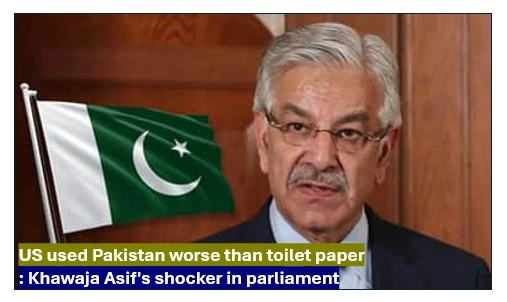

In what is among the most scathing censures of foreign policy in Pakistan’s history, Defense minister Khawaja Asif did not mince his words in addressing a session of National Assembly. On February 9 and 10, 2026, Asif gave a “shocker” of a speech in which he tore away decades of diplomatic politesse to liken the United States’ treatment of Pakistan over history to that being something “worse than toilet paper.”
The comments follow months of intense national turmoil and spikes in cross-border terrorism that have demanded what has been an unprecedented moment of public “soul-searching” by the military-backed civilian leadership.
The “Leased Conflict”: A Microanalysis of the Tissue Paper Analogy
The rented war was the pivot of Asif’s speech. For more than 40 years, Pakistan’s leaders — he specifically mentioned the military dictators Gen. Zia-ul-Haq and Gen. Pervez Musharraf — routinely sold out the country’s sovereignty to Washington in exchange for political legitimacy and financial assistance, he argued.
The metaphor of the ‘toilet paper’ or ‘tissue paper’ was employed to present the concept that there was a cycle of usefulness and discard.
- The 1980s: Pakistan was the “frontline state” against the Soviet Union. All that then remained after the dissolution of the Soviet empire was for US to turn on Pakistan and apply Pressler Amendment sanctions, leaving it with millions of refugees and burgeoning “Kalashnikov culture.”
- Post-9/11: There’s Pakistan in the “War on Terror” cross hairs again. In Pakistan, the Taliban naturally became a liability and facilitated Talibani coups until Washington negotiated its own exit in 2021, gifting Pakistanably Islamist-within states TTP good news for once as well as punishingly bad economy.
“We were used for a purpose, and when that purpose was fulfilled, we were thrown away like a tissue paper — in fact worse than the toilet paper,” Asif said to an audience fallen silent. “The price we paid, losing 80,000 lives and the hundreds of billions of dollars in lost economic activity, can never be repaid.
Challenging the “Jihad” Narrative
But Asif’s even more stunning revelation was the confession of ideologically engineering Pakistani society — a ghastly replica of Neolithic ISIS ideology for terror promotion on the Indian border. For the first time a serving Defense Minister categorically rejected the “holy war” narrative around which Pakistan’s Afghan policy revolved ever since 1979.
The Education of a Conflict
Asif confessed that the state purposely changed the entire school curriculum and history books to make Afghan war, a “Jihad” (holy war) in line with US wishes.
The Reality: He maintained that the wars were politically motivated, a way for the Pakistani regime to prop itself up with the “crutches” of a superpower holding it upright.
The Price: By nurturing radical youth in the education system, the state has spawned a beast it can no longer reel in. Asif said the “ideological shifts of 80s” still remain unaddressed, which play a good host to today’s very sectarianism and extremism that the country was fighting with.
Strategic Miscalculation: 1999 and After
Asif singled out post-1999 phase as one of “severe miscalculation”. He bashed Musharraf regime for jumping into a war already over without any invitation and that was “not ours”. He noted that none of the 9/11 hijackers was Afghan, and yet Pakistan served as the launchpad for a war that destroyed its own tribal areas.
The Domestic Blowback
The response to Asif’s speech has been divided. Supporters consider it a brave acknowledgment of past faults and an essential move toward “sovereign dignity.” Critics, however, note that Asif’s own party has been part of the establishment for years and accuse him of using “dictators of the past” as a scapegoat to avoid taking responsibility for current policy failures.
Donald Trump claims Pakistan PM said he saved lives of 10 million
Conclusion: A Departure from the Past?
Khawaja Asif’s “toilet paper” comment is more than just another viral soundbite, for it is a signal that Pakistan is trying to recalibrate its relations with the West. To plug other debt holes, China will need to sell off reserves consigned to the political and economic scrap heap. How much that “patriotism” extends outside of its own sphere in the real world is anyone’s guess: We may well see interesting shifts in geostrategic posturing from it even as state media insists everyone inside the country blindly support it. But, in recognizing that the ‘Jihad’ was politics and that the coalition was a ‘”rented” alliance’, the Defence Minister has unleashed quite a Pandora’s of historical accountability.

I am a versatile content writer from the MP region, covering politics, business, crime, current affairs, entertainment, video games, and sports with clear insights, engaging analysis, and timely, reader-focused updates.









