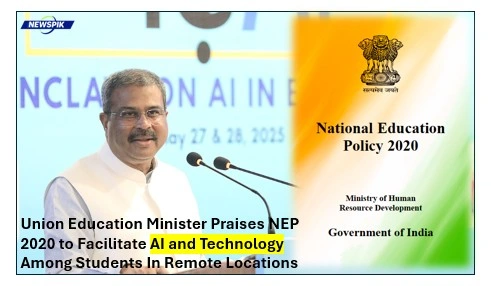

According to Union Education Minister Dharmendra Pradhan, the New National Education Policy 2020 has the potential to bridge the educational divide through the use of AI and advanced technology, especially for students who are from remote or underserved areas.
At the Express Adda forum on February 15, 2026, in New Delhi, Pradhan reiterated that NEP is not simply a policy document but rather a forward-thinking framework to utilize technology as a means to provide inclusive education in India.
Bridging the Gap in Access to Education
According to the minister, “AI, as well as digital technology, is a bridge and a catalyst in bridging the access to quality education, especially in areas with limited physical access to schools and qualified teachers.” He went on to say that NEP encourages using AI and other digital technology to fill learning gaps and to reach remote areas.
“The world has always had AI/technology, however, the NEP now provides new momentum for creating an education system that is both traditional and forward-thinking,” he stated.
New technologies and innovations such as digital learning platforms, AI-enabled teaching tools, and online learning resources will now become integral to how education is presented, as well as lead to more personalized and greater learning outcomes compared to traditional educational practices.
Policy Framework Supports AI Integration
NEP 2020 emphasizes the importance of integrating artificial intelligence and innovative technologies into all educational phases. This is intended to help learners develop computer reasoning, digital literacy, and future-facing abilities from an early age.
AI is seen not just as an area of knowledge to teach but as a mechanism for instruction, assessment, and management of classes. By using both methods, students everywhere can receive high-quality, equal educational opportunities.
Providing Access to Learners in Remote Areas
An important feature of the NEP discussed by the minister is the program’s ability to help solve the gap in access to quality, equitable education for all students. Through online classes, digital content, and AI-enhanced learning, students living in rural and underserved areas will be able to gain equal access to the same level of quality content that students receive in urban areas.
The minister emphasised that physical infrastructures matter, but the introduction of technologies can overcome geographical boundaries to ensure that even remote students will be provided with the skills needed to compete in the workforce of the 21st century.
IT Minister and IBM CEO Respond to Questions on India’s Position in Global AI
The Use of Language and Technology
The minister presented the policy’s orientation in relation to multiple languages and technology and noted that India’s rich and diverse linguistic heritage should be kept intact while also allowing the country to benefit from multilingual platforms for learning, using artificial intelligence.
Technology has been identified by Pradhan as a means of providing content in a variety of regional languages, thereby supporting the National Education Policy (NEP) focus on mother tongue or regional language instruction, where applicable, as previously indicated by the Ministry of Education.
The NEP’s emphasis on technology as an enabler of learning is laudable; however, many stakeholders outside the government such as educators, community advocates, and technology providers have raised serious questions about how devices, internet connectivity, and educator preparedness within many rural areas will impact the ability of these technologies (especially artificial intelligence) to be effectively used in the classroom.
While there are barriers to successfully implementing the NEP, educational policy-makers and technology developers believe that the NEP 2020 will provide a foundation for the transformation of India into a digitally enabled learning society, where there will be no barriers or gaps between what teacher and students can learn through the application of artificial intelligence and technology.
Conclusion: NEP 2020 is a Vision for Inclusive Technology-Enabled Education
Union Education Minister Dharmendra Pradhan has reaffirmed the significance of NEP 2020 as a means to create an inclusive educational environment that incorporates technology. By designating artificial intelligence and digital resources as key enablers of education, the NEP aims to equalise access to educational opportunities for all children in India, especially those in remote locations or underserved communities, to allow them to participate in India’s educational revolution.

A versatile writer mainly works on trending news, daily updates from politics, business, crime, current affairs and entertainment.