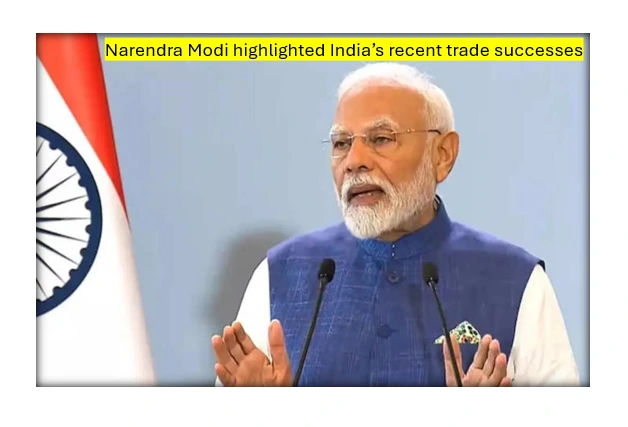

India’s Prime Minister Narendra Modi said that the country can now sign big trade deals because its economy is much better than it was before. He talked about recent talks with global partners and said that stable policies, changes, and the growth of Indian industry have changed how the rest of the world sees New Delhi.
The prime minister said that India is no longer playing defense when it comes to talks. Instead, it is showing itself as a market and a partner that can be trusted. He said that India is more confident at the talking table because manufacturing has gotten better, the service sector is growing, and small businesses are becoming more common.
Modi said that this change did not happen all at once. It was the result of years of work to clean up processes, get people to spend, and make it easier for businesses to run. He said that India could make deals that would help its own growth while also increasing its exports if these things were in place.
Look back at the time of the United Progressive Alliance
The prime minister also used the event to show a difference in politics. He was critical of the time when the country was run by the Congress-led union, but he didn’t name any specific people. He thought that India’s global position and its ability to finalize good trade deals were hurt by bad economic management during those years.
He said that past governments had stopped or failed to move forward because the economy in their own country wasn’t strong enough. He said that things are different now because the fundamentals are better, which means India can seek deals that are in its own best interests instead of giving in when pressured.
Those comments quickly gave a talk about taxes and market access a political edge that it might not have had otherwise.
FTAs and a Greater Role in the World
Modi said that India has signed or is working on free trade agreements with a lot of countries in the past few years. He said that these deals are meant to let Indian goods and services reach new markets, create jobs, and connect Indian companies to global supply lines.
He said that the bigger goal is to make sure that Indian businesses get fair chances to do business abroad and that foreign investors see India as a safe place to do business. By making relationships in more places, New Delhi hopes to have a bigger say in how global business is run.
The government thinks these kinds of deals can help businesses in the United States by opening up new markets and giving them long-term security. For the economy as a whole, the pitch is about making India a key player in how trade moves around the world.
Pushback by the opposition led by the Indian National Congress
But it didn’t take long for the opposition to question what the prime minister said. Leaders of the Congress party said that the words were an attempt to paint an extremely rosy picture while avoiding tough questions.
One of the most angry responses came from Rahul Gandhi, who has asked many times for answers on how farms and small suppliers will be protected. Some people say that trade liberalization needs to be done carefully so that weak groups aren’t put at risk by unfair competition.
People who back the government said that the criticism was unfair because the deals include protections and that increasing exports will eventually help rural areas as well. The conversation is part of a larger discussion about how India can balance being open with looking out for its own interests.

A versatile writer mainly works on trending news, daily updates from politics, business, crime, current affairs and entertainment.