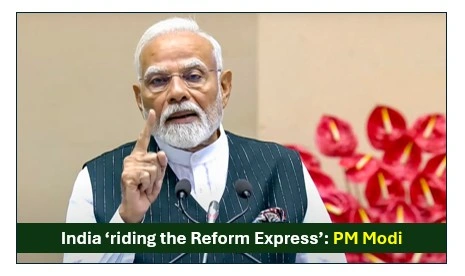

On Feb. 13, 2026, Prime Minister Narendra Modi addressed the world from a podium in New Delhi at the ET Now Global Business Summit and gave a message that was part status report and part manifesto. In a strong metaphor, he said that India is no more merely “on the way” of reform but is “also running the Reform Express.”
The address, titled “A Decade of Disruption, A Century of Change,” described a country that went from being one of the “Fragile Five” in 2014 to being the new dynamo driving global growth. For Modi, the Reform Express is not only about overhauling laws; it’s also a question of mind-set in India.
Conviction Versus Compulsion: The New Reform Philosophy
The most chilling segment of the Prime Minister’s speech was his denunciation of India’s economic history. His portrayal was in marked contrast to the trajectory of past reforms.
The 1991 Ghost
Modi traced the 1991 economic liberalization, a turning point in Indian history, and pointed out that it was born of compulsion. India, at the time was almost bankrupt and had to mortgage its gold. “Compulsion-based reforms do not result in sustainable outcomes,” he stated. In his opinion, such changes were imposed owing to external challenges rather than internal vision.
The Post-2014 Shift
Instead, he said that the present “Reform Express” was driven by conviction. Be it the rationalization of GST, new labour codes or radical simplification of the Income Tax Act, all these steps were taken on their own.
The Four Reformer Pillars Express
To work out what is driving the “Express,” we need to examine the individual areas in which the Prime Minister placed emphasis. His vision for 2026 and beyond is based on four main engines:
Infrastructure and Capex Multipliers
The investment outlay in the Union Budget for 2026-27, at ₹17 lakh crore ($170 billion), is mind-boggling. This is not just pouring concrete, it’s the “multiplier effect.” Modi listed the nod to seven new high-speed rail corridors and five university townships as projects that would generate jobs immediately but also develop capacity over time.
The Digital Public Good: UPI and more
“The prime minister said UPI is no longer a mere mobile payment app, but a global-impact reform,” according to the statement. It is the best that policy, process and delivery could possibly meet. Elevating the “Jan Dhan-Aadhaar-Mobile” trinity to the heart of governance, the Reform Express has made financial inclusion a right rather than a privilege for the ”neo-middle class.”
Technology and the “Sunrise” Sectors
India is wagering big on the future. Modi outlined a number of “Shakti” missions to make India a hub for the world:
- Semiconductor Mission 2.0: From assembly to creating and making chips themselves.
- Bio-Pharma Shakti: India will be transformed from a quantity-based pharmacy to value-based powerhouse of innovation with an outlay of ₹1,000 crore (₹10 billion).
Outcome over Outlay
One of the most dramatic differences for the Reform Express is how government measures its success. Modi said that for decades, Budgets had been measured by how much money was allocated (the outlay). Now it’s on the result.” The administration is now monitoring the exact number of houses built, “Lakhpati Didis” (women from self-help groups who earn over ₹1 lakh per year) created, and start-ups registered.
The Final Destination: Viksit Bharat 2047
And the country should think hard about that coming horizon, he suggested. Even though the Reform Express is rushing in 2026, the ultimate destination is “Viksit Bharat” (Developed India) by 2047.
He called on the country to be ready for the “disruptions” that will face us in future “; most notably, those led by Artificial Intelligence. Instead of fearing change, he said, India must be the driver of it. And the message was unmistakable: The Reform Express has left the station, it is chugging right along and it is not slowing down.

I am a versatile content writer from the MP region, covering politics, business, crime, current affairs, entertainment, video games, and sports with clear insights, engaging analysis, and timely, reader-focused updates.