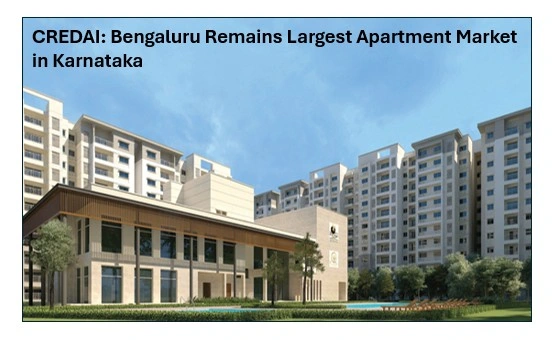

It is arguably the success story of modern India’s urbanisation, and one city in Karnataka still holds onto it so tightly that its shadow looms large even 20 years later: Bangalore. If we were to go by the latest numbers and what industry body Confederation of Real Estate Developers’ Associations of India (CREDAI) is saying, Bengaluru is the one city that continues to be a league in itself when it comes to apartment market tractions as neighbouring tier-2 cities come out quietly on their slow-burn journey.
The numbers tell a tale of sheer scale. As on February 2026, there are close to 8.7 lakh housing units in the pipeline in Karnataka from over 4400 projects registered with RERA. Saturation conditions It’s not just the acute scarcity of houses that has created such a demand skew; only a sliver of India, the “Silicon Valley of India,” is largely responsible for it.
The Vertical Revolution: Why Bengaluru Lives in Apartments
For Bhaskar T. Nagendrappa, President of CREDAI-Karnataka, the supremacy is not just about brick and mortar; it’s a lifestyle shift that has now become permanent post-pandemic. “While plotted development still rules in the hinterlands, Bengaluru has completely transitioned to the ‘vertical village’ way of life,” said Nagendrappa in a recent industry briefing.
The tech ecosystem continues to be the dominant engine. The demand for high-rise living has clearly grown beyond the other formats owing to (a) the sustained addition of global capability centers (GCCs) and employees who prefer homes proximate to suburban office clusters such as Whitefield, Hebbal, and ORR.
“Earlier, growth was chasing water; today, it is chasing infrastructure,” Nagendrappa said, echoing the sentiment that the Metro’s Phase 2A and 2B lines can be transformative.
2025-26 “surprising statistic” isn’t just the sheer volume of sales, but its status as the lowest inventory overhang in the entire country—at a trim 10 months. In a sector where in many markets developers are stuck with large unsold stock for years, Bengaluru’s ability to absorb almost 70,000 homes every year illustrates a maturity that other Indian metros envy.
Read more: Bengaluru’s ‘white water’ revolution: How apartments are powering
A Squeeze on the Middle Class: The ₹1 Crore Threshold
But the sunniest of news from CREDAI conveys a shadow of warning for the common house buyer. The city is in the midst of an affordability crisis that is recasting who can afford to stay.
Two pieces of market intelligence are bound to cast a wet blanket on such high-brow cheer: as many as 42% homebuyers, under the ₹1 crore segment have been effectively “priced out” from the property business. With land prices soaring and developers shifting focus to premium and luxury projects for a cushion in margins, the condition is no different for the once-prosperous “affordable mid-segment”.
- Luxury Surge: Luxury housing comprises 35 percent of the city’s new supply.
- Price rises: The average price of a property in 2025 was up by nearly 12% compared to the previous year, rising to around ₹7,388 per sq. ft. citywide.
- The Peripheral Push: Demand is pushing first-time buyers to consider corridors much further away such as Kengeri, Jigani and Doddaballapur Road where the infrastructure does not match construction time.
A 2BHK apartment within city limits can now only be a dream house for most of the aspiring professionals, who would instead have to choose between a 40-year-old place in CBD or a water-hogging gated community which is an hour’s drive from their workplace.
Read also: Bengaluru–Mumbai Premium Train Service to Start Soon
Beyond the Metro: The Tier-2 Awakening
So while Bengaluru continues to be the ‘nerve center,’ CREDAI is increasingly casting its eyes on some of the state’s rising urban hubs for balance. Mangaluru, Mysuru, Hubballi and Belagavi are beginning to welcome apartment culture.City residences get commodious.
The erstwhile State’s second biggest market Mangaluru Maker02: has continued to assert its supremacy as the second largest market in the state due to educational and industry establishments. At the same time Mysuru is reaping the benefits of being a heritage and tourism destination, with infrastructure upgrades turning it into an attractive “satellite” option for those looking to escape the fast pace of urban life.
“The government has to increase employment in these cities,” says Ramachandra CH, Joint Secretary of CREDAI National. “The money that is generated through industrial growth ultimately flows into housing.

I am a versatile content writer from the MP region, covering politics, business, crime, current affairs, entertainment, video games, and sports with clear insights, engaging analysis, and timely, reader-focused updates.