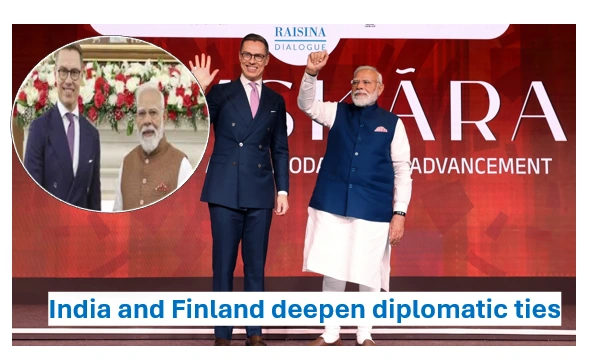

There is a peculiar Nordic chill in the air this week in New Delhi, but there was nothing chilly about the atmosphere in Hyderabad House. The Prime Minister Narendra Modi and the Finnish President Alexander Stubb sat face to face not only as heads of state, but as the creators of a Strategic Partnership in Digitalization and Sustainability.
This state visit does not take place by chance. It comes on the heels of the historic signing of the India-European Union Free Trade Agreement (FTA) in early 2026, a historic deal that has placed the stage for a golden age in the Indo-European relations. It is in the context of instability in the world, the continuing effects of the Ukrainian conflict, as well as of recent events in West Asia, that India and Finland have decided to forge a bridge of innovation and green transition.
Between 6G and Green Hydrogen: A Tech-First Alliance
The first point of contact in the new accords is that of obsession with the future. The 20th century was characterized by oil and steel, however, the 21 st -century collaboration between New Delhi and Helsinki is being coded and carbon neutral.
The Joint Task Force on 6G between the two countries is officially a connection between the world-known research conducted by the University of Oulu and the Bharat 6G Alliance. It is not only about making downloading faster, but about developing what Prime Minister Modi kept repeating; trustworthy technologies. During a time of deepfakes and cyber-war, India and Finland are setting themselves as the safe hands of the global digital ecosystem.
Read also: India and New Zealand announce Landmark Free Trade Agreement (FTA)
Putting a Face on Figures: The “Talent Corridor”
In addition to the high-level policy speak, the Migration and Mobility Partnership Agreement is the most significant agreement to the average citizen. To the thousands of Indian IT professionals and students who aspire to the Nordics, this agreement is the permit they are seeking in the form of a fast-track.
Indian talent has always been perceived by Finland as the secret weapon to a declining work force and a thriving technology industry. On the other hand, Finland views India as a high-tech living laboratory, where its engineers can perfect their capacity in the niche or specialization such as quantum communications and sustainable city planning.
PM Modi commented on the joint statement by saying that Finland is now a destination of our talent. It is not only about brain drain, but a flow of expertise in a circle. In this regard, the Indo-Finland Startup Corridor was initiated, which aims at assisting Indian startups in demonstrating their solutions at Slush in Helsinki, and Finnish innovators to get an enormous market at the Startup Mahakumbh in India.
A Shared Green Vision: The Circular EconomyIt is specifically ambitious environmental cooperation that is being reinforced this week. India and Finland have now signed an agreement to co-host the world circular economy forum 2026 in India.
To the Finnish delegation, it is an opportunity to sell the world-leading wastage-to-wealth technologies. For India, it’s a necessity. Finland has experience in bioenergy and small hydropower, which is scalable, and it comes at a time when the Ganga has to be cleaned and a solution is needed on urban waste management of its mega-cities.
According to President Stubb, the contribution of Finland to the Indian journey of Viksit Bharat (Developed India) is already evident. He cited the tallest railway bridge in the world above the Chenab a construction project with Finnish know-how and the bamboo-to-bioethanol refinery in Assam as evidence that this alliance is not merely on paper but up in the infrastructure.
Read also: A bilateral EU & India Free Trade Agreement: Updates
In a Tempestuous World Diplomatic Anchors
The explanations were not confined to trade. At one of the infrequent instances of outspoken diplomacy, the two leaders spoke on the issue of instability and uncertainty which is troubling the international order. They made a common appeal to terminate early in Ukraine and West Asia conflicts and renewed their adherence to a rules-based order and the UN Charter.
President Stubb also used the chance to support the bid of India that it be granted a permanent seat in a reformed UN Security Council, since the world governance frameworks of 1945 are not applicable any longer to the 2026 realities.

A versatile writer mainly works on trending news, daily updates from politics, business, crime, current affairs and entertainment.









