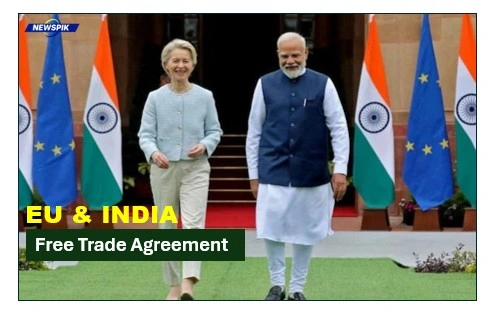

After nearly 20 years of often arduous discussions, the European Union and India are now close to finalizing a broad Indian Free Trade Agreement, which could redefine the economic relationship between the Indian sub-continent and these European countries. Sources from the highest level within the Indian government, as well as the European Union, are claiming the FTA will likely be announced imminently, perhaps even interrelated with the upcoming EU-India Summit, which will likely take place in New Delhi around the time of the Indian Republic Day Celebrations in 2026.
The pact has been viewed as a prospect for being the largest trade deal ever concluded by India and will include trade in items, services, investment, and regulation. European leaders have called the deal ‘historic,’ and this is because the accord is significant not just due to its reach and scale, as well as being symbolic with strategic significance amid rising international protectionism.
These key leaders include India’s Prime Minister, Mr. Narendra Modi, and the President of the European Commission, Mr. Ursula von der Leyen. They are expected to take the lead in ratifying the agreement as they have agreed to conclude the agreement in their bilateral high-level meetings.
What the Agreement Covers (and Doesn’t)?
The EU-India FTA seeks to substantially liberalize the external trade between the 27-member EU bloc and India:
- Goods: Substantial reductions in tariffs on a variety of goods and products are expected, which would boost trade flows in machinery, chemicals, and automotive markets.
- Automobiles: India has planned to slash tariffs on imported EU cars, which are currently the highest around the world, by as much as 40% now and then by further reductions thereafter.
- Services: Improved market access in IT, finance, and professional services will reportedly be one of the elements in the bargain, but details on it are still awaiting conclusion.
However, sectors which are considered to be too sensitive for inclusion, like the agricultural sector, the dairy industry, and certain sanitary items, are kept out of the immediate negotiations owing to political considerations, especially the Indian side.
The Generalised System of Preference (GSP), via which earlier the EU used to offer concessional lower tariffs on Indian exports to its territory, has been revised or suspended as Indian economic growth exceeded the threshold. The data indicates that this will result in minimal impacts on exports to the extent of only 2.66% of total exports out of India, say sources.
Economic and Strategic Benefits: Boost to Bilateral Trade
Already one of India’s largest trading partners, the EU is expected to see a substantial rise in bilateral trade flows with India under the FTA through the facilitation of cost barriers and competitiveness.
For India, it can help in bringing diversity in markets of export and thus offset tariff disadvantages in other major markets, like the U.S., where Indian products are subjected to higher duties.
Market Access and Investment
Access to India’s large and growing consumer market—projected to be more than 1.4 billion people—could further accelerate European investment into Europe, especially in manufacturing, green technologies, and advanced services sectors.
On the other hand, Indian exporters can also get lower duties on textiles, pharmaceuticals, and engineering goods in large EU markets.
India Wins Third Free-Trade Deal This Year With NZ Agreement
Strategic and Geopolitical Significance
Aside from economics, the FTA underscores deeper EU-India strategic cooperation at a time of changing global alignments. The deal has been presented by European officials as part of broader efforts to decrease dependence on any single economic partner, especially against U.S. trade policy uncertainty.
It is further aligned with joint working plans on climate action, key supply chains, and the economic connectivity frameworks like the India-Middle East-Europe Corridor.
Remaining Challenges
Despite all the historical advancements, some key issues remain unresolved:
- Tariff and Market Access: There are differences over the extent and speed of the reduction for automobiles and alcoholic beverages.
- Non-tariff measures: including standards and certification processes, remain some of the thorniest regulatory barriers.
- Climate and Carbon Costs: CBAM has raised several concerns for Indian exporters despite a negotiation process in full swing to reach pragmatic compromises.
- The negotiators on either side of the divide have been holding intensive talks to narrow down their differences, with several rounds of talks underway.
India and New Zealand announce Landmark Free Trade Agreement (FTA)
What’s Next?
With the IndiaEU Summit scheduled for the end of January 2026, both parties are hopeful that the contours of this deal will soon be finalized. The deal will then move into ratification and eventual implementation.
In fact, after years of negotiations on this trade pact, this is poised to come at a strategic juncture when it will seek to connect two large economic blocs in a highly protectionist era.

I am a versatile content writer from the MP region, covering politics, business, crime, current affairs, entertainment, video games, and sports with clear insights, engaging analysis, and timely, reader-focused updates.