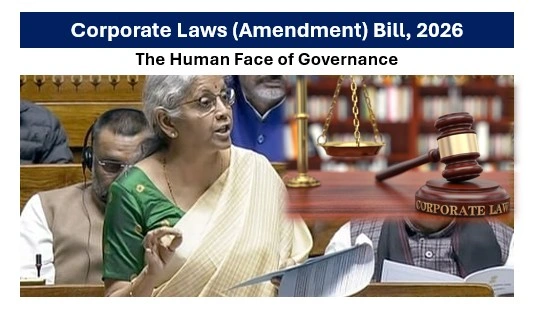

A new book in the story of Indian economics is being written in the busy lobbies of the Sansad Bhavan where there is a tendency to have a lot of political discussion and lawmaking language in the air. The Corporate Laws (Amendment) Bill, 2026 is to be presented in the Lok Sabha by Finance Minister Nirmala Sitharaman, which, at first glance, appears an unenthusiastic move to update the bureaucracy.
Nevertheless, to millions of entrepreneurs, owners of small businesses and startup founders throughout Bharat, this Bill is anything but dry. It is a paradigm change in the perception of the state towards the risk-taker. It is a transition point between the fixed forms of the old and the flux, digital-first economy of the new.
Why Corporate Law Counts To the ordinary citizen?
When Corporate Law is mentioned we tend to imagine glass-sky buildings and men in pinstriped suits. The truth about Indian economy lies in the garage start-up in Bengaluru, the family owned manufacturing facility in Ludhiana and the expanding lady-led co-operative in Kerala.
The Philosophy of Trust- Based Governance
Minister Sitharaman has often talked of Minimum Government, Maximum Governance. That philosophy has been given a legislative form in this Bill. It leaves behind a culture of mistrust- where all clerical mistakes were expected to be seen as crimes- and a culture of teamwork.
It is not merely a case of correction in parts of a book, as one of the top officials in the Ministry of Corporate Affairs (MCA) observed before the session. We are correcting the association between the regulator and the regulated.
The 2026 Amendment: The Pillars of Change
It is anticipated that the Bill will be rather comprehensive, as it will cover the Companies Act, 2013, and the Limited Liability Partnership (LLP) Act. The following is an overview of the anthropocentric changes that will be in the limelight:
The third wave of decriminalization: Making the “Honest Mistake” a legal nonperson. Fear of jail time due to technical default is also one of the greatest challenges facing first-time entrepreneurs. Bill 2026 goes even deeper into decriminalizing it. It differentiates between the fraudulent intent and the procedural lapses.
The Emergence of the so-called Digital Native Corporation
The pandemic made us realize that a boardroom is at any point where a laptop is open. This is a reality that the 2026 Amendment has finally realized. It proposes:
- Virtual-First AGMs: Ensuring that digital Annual General Meetings becomes a part of the permanent system will save small companies money.
- Digital Signatures and blockchain registries: A step towards a paperless compliance ecosystem that minimises the inspected raj and minimises human intervention.
Read also: Budget 2026-27: What to expect?
Enhancing the Backbone of an Independent Director
Corporate India has been enjoying its fair share of turbulence in the last few years. The Bill attempts to secure protection of the small shareholder, the retired teacher who invests his savings with a mutual fund or the young professional who has entered into the stock market by making the Independence Directors much more accountable and at the same time gives them a measure of protection under the banner of Safe Harbor as long as they are acting in good faith.
Making the Startup Ecosystem more human: The Sunrise Provision
The Bill of the Corporate Laws (Amendment) 2026 is highly exciting in that it focuses on the so called Sunrise industries- tech, green energy and space-tech.
The compliance cost can be very steep to a startup founder compared to their operating cost. The Bill also proposes a new category, the Micro-Company that has even weaker compliance criteria than the existing definition which is the Small Company. This is a direct allusion to the millions of micro-entrepreneurs who are the source of the Atmanirbhar Bharat vision.
Read more: Parliament approves Manipur GST Bill 2025
Helping the Grit of Female Founder
We are hearing rumors of certain policies to encourage female participation in high-growth startups, not as a diversity requirement, but as an economic weapon. The Bill aims at introducing more domestic kitchen-table businesses into the formal economy by streamlining the regulations of women led LLPs.

I am a versatile content writer from the MP region, covering politics, business, crime, current affairs, entertainment, video games, and sports with clear insights, engaging analysis, and timely, reader-focused updates.









