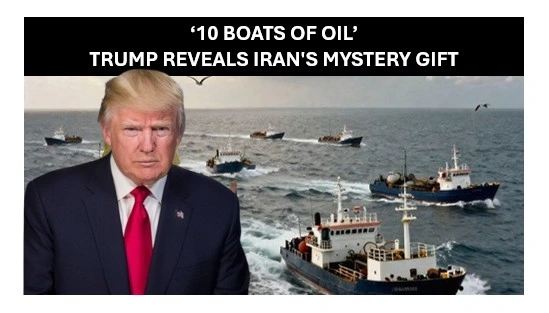

According to Donald Trump, President of the US, Iran has granted ten oil tankers permission to traverse the Strait of Hormuz, a vital waterway of great significance. Trump’s claim is based on the assertion that the extended number of tankers being permitted to traverse the Strait should be considered a sign of “good faith” between Iran and the United States.
Trump claims that initially there were eight oil tankers approved for passage through the Strait, but later the determination was made to increase the number approved to ten. This may also indicate that the ten oil tankers may be sailing under different flags, other than Iranian flags.
The implications of this agreement are great:
If tankers are able to pass through the Strait of Hormuz (which carries roughly 20% of the world’s oil supply) it will have almost immediate ramifications around the world.
There have been recent naval confrontations between the United States and Iranian vessels, multiple vessel attacks against vessels, and threats made by Iran to stop oil shipments. As the number of vessels that will be able to navigate the Strait will increase along with a higher risk of an armed confrontation due to these threats, the ability to successfully navigate the straight will be of the utmost importance.
The fact that for a limited amount of time, vessels will be allowed to transition through the Strait, may indicate that there is a chance that the tensions between these two countries may ease.
Is This Considered a Diplomatic signal or a Strategic Message?
President Trump counts this action as evidence that Iran desires an end to hostilities while attempting to negotiate.
This announcement comes at a time when:
- U.S. policymakers continue to ask Iran to abandon its nuclear program;
- There has been an increase in back-channel diplomacy; and
- U.S. Forces continue to operate under a great deal of pressure.
Some reports suggest that this ship passage may be a part of a larger negotiation process and there is an element of goodwill in both parties trying to determine whether they are willing to barter.
Read also: 7 Demands from Iran to end war with US
Confusion Over the “Gift”
In spite of a bold statement, some key aspects of the situation remain ambiguous:
- Who owns the oil?
- What are the destinations of the tankers?
- Are these tankers headed to the U.S., as stated?
Neither the White House nor Iran has provided additional information about the claim. These variables have given rise to speculation regarding:
- Whether this is a legitimate diplomatic gesture, or
- If it is only a political or symbolic message.
The announcement of this possible diplomatic concession comes on the heels of increasing tensions and military conflict between the U.S. and Iran, with activities such as:
- Attacks on oil tankers
- U.S. air strikes on Iranian naval targeting
- Increasing oil prices and instability in the market
Relative to this context, even an easing of restrictions on ship movements could be viewed as a step towards relaxation of tensions between the parties involved.
Another element is that some reports state that these tankers may be registered under the flag of a foreign country (e.g., Pakistan), which may provide a suggestion of communication facilitation between the U.S. and Iran via back channels.
Countries such as Pakistan and others may play a greater or lessor role in back-channel communication with either side in support of diplomatic efforts.
Ultimately, while the story of the “10 boats of oil” and other aspects related to this event is making headlines today, its long-term impact remains uncertain.
Read more: US-Israel attacked Iran’s nuclear facility
Key questions ahead:
- Will this result in diplomatic discussion or an end to hostilities?
- Is Iran suggesting a general change in foreign policy?
- Or is this merely an opportunistic strategy?
For now, this incident serves to demonstrate how closely connected energy, geopolitics, and communication are in the ongoing standoff between the U.S. and Iran.
Bottom Line
According to reports, the “mystery gift” from Iran consists of ten tankers full of oil. However, the shipment represents more than just oil and is representative of the balance of power, perception, and diplomacy between the two nations. Whether these ten tankers will mark the start of continued de-escalation remains to be seen, but what is certain is that they provide yet another twist in a long history of rising tensions.

A versatile writer mainly works on trending news, daily updates from politics, business, crime, current affairs and entertainment.