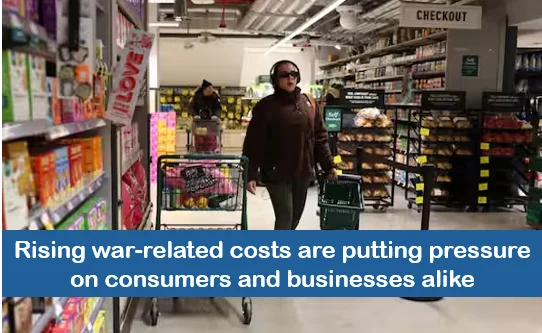

Companies in the US are warning more and more that customers are tired of spending money after the Iran war caused fuel and energy prices to rise sharply, forcing them to rethink their pricing, promos, and ways to make money.
After the war in Iran caused a global energy shock that sent fuel prices sharply higher and forced companies across all industries to rethink their pricing, sales, and investment plans, corporate America is sending more and more mixed signs about the health of the US consumer economy.
This week, leaders from companies like Kraft Heinz, Whirlpool, Lufthansa, and McDonald’s talked about how the American customer is becoming more careful after months of rising prices for food and gas due to the military conflict in Iran.
Kraft Heinz CEO Carlos Abrams-Rivera Cahillane told The Wall Street Journal, “Consumers are literally running out of money toward the end of the month.” He warned that pricing has become important as families struggle to handle higher living costs.
The comments show a bigger worry that’s going around in boardrooms and earnings calls: spending on necessities, travel, and entertainment is still surprisingly strong in some parts of the economy, but many businesses are now seeing clear signs of “spending fatigue” as customers cut back, put off purchases, and choose value over luxury items.
Businesses switch to offering deals and cheaper goods
Kraft Heinz said it was lowering the prices of some items, running more sales, and putting them in smaller packages to keep people buying even though the economy was getting worse.
The company had thought about going out on its own before, but now it has a $600 million investment plan passed by its board to try to grow again within the company.
Executives said that years of inflation had already hurt sales, and the conflict with Iran added more unpredictability by making the cost of oil and transportation go up.
Cahillane said, “We had four years of volume decline because consumers had to take on too much price.” “No one wants to see another wave of inflation.”
To protect its market share against cheaper private-label competitors, the company is also changing the way its products are packaged and putting more money into marketing.
Whirlpool says there will be a “recession-level decline”
Even more obvious were the warning signs at Whirlpool, which said that the equipment market was like being in a slump.
The US company stopped giving out dividends, lowered its earnings forecast, and said that people were really not buying big-ticket items like freezers and washing machines.
Following the start of the Iran war in late February, chief financial officer Roxanne Warner said that customer trust had “nosedived to historically low levels.”
Warner said, “We think that’s completely due to the fact that people are being a little more careful about how much they spend.”
The company said that people were still buying new appliances to replace broken ones, but they were picking cheaper models over more expensive ones that made the business more money.
Read also: China opens its market to Africa with no tariffs, while Trump pushes for new import taxes
After the earnings report, its shares dropped almost 20%
Fuel prices are going up for airlines.
If there are problems around the Strait of Hormuz, Lufthansa said that growing jet fuel prices could make costs go up by €1.7 billion this year.
The airline said it might be able to help by raising ticket prices, cutting flights, and speeding up its attempts to restructure.
A lot of airlines, like EasyJet and Virgin Atlantic, have also said that long-term fuel price increases could hurt their profits a lot. Some experts are even saying that long-term problems could even cause parts of the flight industry to go bankrupt.
Lufthansa said it had already cancelled 20,000 flights from its summer plan to save money on fuel and deal with the stress of the war on its operations.
Value meals are becoming more important to fast food companies
Restaurant chains, on the other hand, are trying to find a good mix between getting budget-conscious customers and keeping their profit margins safe as food and fuel costs rise.
McDonald’s reported better-than-expected quarterly sales of $6.5 billion, thanks in part to bold value offers and bigger orders from customers.
To attract customers who are struggling financially because of inflation and higher gas prices, the company has added more things to its menu that cost less than $3 and made breakfast packages that cost less.
However, CEO Chris Kempczinski worried that customer opinion was getting worse
Even though there were worries that business would slow down, same-store sales at McDonald’s restaurants in the US went up 3.9% in the most recent quarter.
Executives did admit, though, that rising fuel prices and beef prices could finally make low-income families spend less later this year.
Read also: Pakistan Says It Has Only Days of Oil Reserves, Not Months, as Global Prices Rise
Not all industries are having a bad time
Still, some companies that deal with customers say that spending is still holding strong despite the political unrest.
This week, both the ride-hailing giant Uber and the entertainment company Walt Disney reported strong demand. This suggests that higher gas prices have not yet had a big effect on how much people spend on travel, entertainment, and local services.
Dara Khosrowshahi, CEO of Uber, said the company was still seeing strong demand for rides, food delivery, and restaurant spending.
He said, “At this point, we don’t see any signs of that weakening”
Disney also said that its parks and resorts in the United States were getting a lot of bookings. However, executives did say that they were aware of the possibility that rising energy costs could finally put a strain on people’s budgets.

I am a versatile content writer from the MP region, covering politics, business, crime, current affairs, entertainment, video games, and sports with clear insights, engaging analysis, and timely, reader-focused updates.