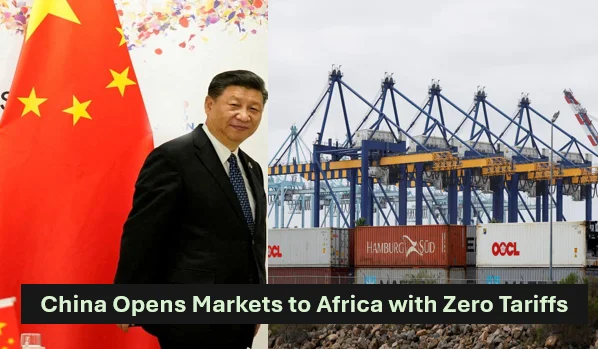

China has officially started a new tariff-free trade policy for Africa’s biggest economies. For the next two years, these economies will be able to enter China’s market without having to pay any duties. This is part of Beijing’s plan to strengthen economic ties with Africa as trade pressures rise around the world.
The policy started on Friday and applies to the 20 biggest economies in Africa. These include South Africa, Egypt, Nigeria, Algeria, and Kenya.
China had already taken away duties on 33 lower-income African countries
This means that 53 of Africa’s 54 countries can now send goods to China without having to pay customs.
Only Eswatini is different; it is the only country in Africa that has official foreign links with Taiwan instead of Beijing.
The Customs Tariff Commission of China said the plan was meant to help China and Africa reach “common development.” State-run Xinhua News Agency said that 24 metric tonnes of apples from South Africa were the first shipment under the new policy to clear customs in Shenzhen early Friday morning.
read also
- China blocks Meta’s $2 billion AI deal, shocking the tech industry worldwide
- China and Pakistan Offer 5-Point Peace Plan to Stop Iran War
- US attack triggers panic in China
The zero-tariff plan will help African farming products
China’s Commerce Ministry says that the zero-tariff plan will help African farming products like cocoa from Ivory Coast and Ghana, coffee and bananas from Kenya, and wine and citrus fruits from South Africa. A lot of these goods used to have taxes that were between 8 and 30 percent.
More than half of the world’s cocoa comes from Ivory Coast and Ghana. South Africa is one of the biggest producers of orange fruits.
The move comes as many African economies try to find new export markets after the Trump administration put tariffs on goods coming from certain countries. Washington had previously put taxes on imports from several African countries that worked both ways. For example, some South African goods were taxed at 30% and others were taxed at more than 40%.
The US Supreme Court later ruled that Trump’s higher global tariffs were illegal, but the administration quickly put in place temporary import taxes to replace them.
It is already the biggest trading partner of Africa. In 2025, trade between the two countries reached a record $348 billion. The trade partnership is still very unequal, though.
China sent about 25% more goods to Africa last year, worth $225 billion. But Africa only sent about 5% more goods to China, worth $123 billion. This made Africa’s trade gap with Beijing bigger.
China has traditionally bought raw materials like oil and minerals from Africa and sent finished goods back to the continent. Analysts say that the new policy of no tariffs could make it a little easier for African farming goods to get to markets, but it might not change the imbalance in a basic way.
Thierry Pairault, an expert on China and Africa at France’s National Center for Scientific Research, said that the move was also meant to improve China’s image around the world at a time when Western nationalism is being criticised more and more.
“Xi Jinping is making China look like the opposite of Western protectionism,” Pairault wrote in a report released by the China Global South Project.
He did say, though, that the policy mostly applies to areas where China doesn’t have to pay a lot of money. For example, he pointed out that many African raw material products already had free access to Chinese markets. China has launched a new tariff-free trade policy for Africa’s biggest economies, giving 53 of the continent’s 54 nations duty-free access to Chinese markets.

A versatile writer mainly works on trending news, daily updates from politics, business, crime, current affairs and entertainment.