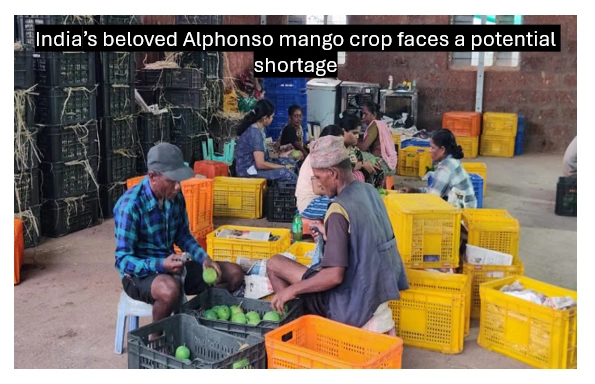

People in Maharashtra’s Konkan mango belt are sad because their mango trees, which should be full of fruit in April, are barren. Yield down 80%, and prices across the country are likely to rise.
In the hot month of April, Suresh Kelkar’s warehouse in Devgad, Konkan, would be filled with the smell of Alphonso mangoes. Mangoes would be picked from the garden next door and piled in the building by workers.
But not this year. There aren’t many things in the building or on the mango trees this April. The crates are only half full, and the trees should be full of fruit but aren’t.
In my 40 years of work, this is the first time we’ve had such a crisis
It was almost 95% of the first bloom that was lost. All of our hard work was for nothing, and this is a huge problem for us. “About 10 to 15 percent of what we normally make has been made this year,” Kelkar told ThePrint.
According to the government, this mango season’s production has dropped by 70 to 90%, limiting the amount of fruit available on the market to 10 to 20% of what it normally would be. The prices of this type of mango are likely to go up in all 50 states because of this.
This is mostly because of the long rainy season, the hard winter, which speeds up blooming, and herbicides that don’t work.
The farmers in Konkan had to take to the streets in a rare show of protest to demand money from the government.
Raju Shetti, a farmer leader, led the protest. He wanted farmers to get Rs 5 lakh per plot as settlement and have all of their farm loans forgiven.
Mango farmers did get some money from the government, but it was only Rs 22,000 per acre, which the farmers turned down.
At first, the government only made promises. But when we held a protest, Guardian Minister Nitesh Rane kept his word. While the assembly session was going on, the government announced very low pay. “We reject it,” said Nilesh Pednekar, a member of the Amba-Kaju Vyapari and Bagaydari sanghatna, Devgad, the group that took part in the protest last month.
Read also: Fruit Juice or Sugar Syrup Row Reaches Parliament
Konkan, which is on the coast of Maharashtra, is known for its Alphonso or Hapus peaches
Aside from mangoes, farmers here also grow peanuts, jackfruits, kokum, and other foods that can be sold.
This area of land has a thick, rich layer of well-drained sandy clay and red laterite soil, making it ideal for growing peanuts and mangoes, which are very important to the local economy.
Devgad in Konkan is famous for its Alphonso because it has a unique taste and smell. The right amount of acid and sugar in Devgad mango makes it stand out.
Many sellers sell their mangoes under the name Devgad Alphonso to get better prices. The government gave the GI (Geographical Indication) tag to stop the problem because it was happening so often.
There are lots of mangoes in Maharashtra from February to May. But it has been badly affected this year. Of the two Konkan districts, Sindhudurg and Ratnagiri, Devgad Taluka is the worst hit. Many farmers there say their crops have dropped by as much as 70 to 90 percent.
Kelkar said that at this time last year he had 3,000 to 4,000 crates of mangoes and expected 5,000 to 6,000 boxes this year. But now he says the production will be only half of what it was. There are 25 kg of mangoes in one box.
Read also: 15 Unforgettable Experiences To Have In India This Summer
The fruit business
One of the most important things for the Konkan area, especially Ratnagiri and Sindhudurg, is the mango trade and the business that supports it. Every year, 225,000 tonnes of alphonso are grown in Ratnagiri and Sindhudurg alone. It is thought that between 2.5 lakh and 3 lakh people in Sindhudurg district alone depend on the mango trade.
Farmers in Konkan usually grow cashews and fruits
They are thought to be wealthy because they make a good return every season.
The economic study 2025–26 says that 1.67 lakh hectares of land in Maharashtra are used to grow mangoes, with 1.23 lakh hectares of that land being in Konkan.
Ratnagiri and Sindhudurg districts in Konkan are important for growing Alphonso. In Ratnagiri, 68,550 hectares are used to grow mangoes, and in Sindhudurg, 34,760 hectares are used for mango cultivation.
The meeting minutes from March 23 show that, as of December 2025, non-performing assets (NPAs) as a percentage of all agricultural advances are 6% in Sindhudurg. This is lower than the 34% in Kolhapur, in western Maharashtra and the 24% in Chhatrapati Sambhajinagar, in the Marathwada region.
That’s why it’s so clear that Konkan farmers have had a hard year this year
The government says that production of the Alphonso mango has dropped by 85 to 90 percent in the Konkan district of Sindhudurg and by about 70 percent in Ratnagiri. In Raigad, which grows the Alphonso variety as well as others, production is down 60%. In Thane, which grows a different type, production is also down 60%.

I am a versatile content writer from the MP region, covering politics, business, crime, current affairs, entertainment, video games, and sports with clear insights, engaging analysis, and timely, reader-focused updates.