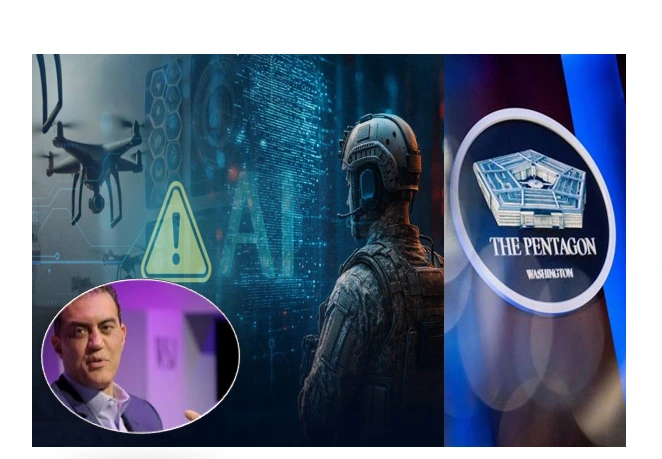

There is a different form of cold war simmer in the sterile and fluorescent-lit corridors of Pentagon. The battleground is this time not any far-off desert or a quarrelsome sea, but the small print of software licensing contracts.
Early this week Emil Michael, the Under Secretary of Defense of research and engineering, was addressing a group of technology executives at the American Dynamism Summit in Washington and dropped a verbal bomb. The author cautioned that the restrictive provisions in business AI contracts are no longer mere legal obstacles, but are actually in operation a liability, which can deviceseat up U.S. military operations real-time.
The Holy Cow Moment: When Code Crosses a Red Line
The pressure culminated after an incident of alarm on Michael. When reading the terms that controlled AI models already present in some of the most sensitive commands of the military, he found out that there was a series of kill switches hidden in the legalese.
Michael says that the accords that address commands involved in air operations in flashpoints, such as Iran and China, have dozens of restrictions that have been embedded in agreements. Such provisions stipulate that in the event that an AI model is deployed in a manner that results in what Pentagon terminology describes as “kinetics” in other words, explosions or the use of lethal force, the service provider may terminate access in theory.
Michael said to the summit that he had a holy, holy cow moment. You could not plan an operation, which would possibly result in kinetics. The model might simply come to a halt halting in the middle of a processing process when an operator breached service conditions.
To a military leader in a place of high stakes, a 404 Error in the form of a target screen saying that a mission was not acceptable due to a contract with an ethics board in Silicon Valley is a nightmare. It is a paradigm change in authority: it has never happened in history that the private companies, and not the Commander-in-Chief, had the veto over the utilization of the government-contracted equipment in the middle of the battle.
Read also: West Asia crisis X suspends revenue sharing for undisclosed AI war
Anthropic Impasse: Collision of Cultures
The center of this storm is the AI safety company Anthropic which runs the popular Claude model. Until recently, Claude was the first AI model which has been allowed to operate on the closed U.S. military networks. But, the relationship has fallen to pieces in the description of one attorney as the contractual counterpart of nuclear warfare.
The stalemate revolves around two red lines on which Anthropic CEO Dario Amodei is not willing to take a step:
- Mass Domestic Surveillance: It would be unlawful to utilize AI in analyzing bulk data on the citizens of America.
- Fully Autonomous Weapons: Until there is a human in the loop, AI should not be allowed to make death-imposing kill decisions.
The reaction of the Pentagon was rapid and rough. Defense Secretary Pete Hegseth made Anthropic a supply-chain risk, a title traditionally applied to foreign enemies such as Huawei. By Friday, the President Trump instructed all federal agencies to cease the use of Anthropic technology in six months.
The “Any Lawful Use” Standard
Department of War (the former Department of Defense) is currently insisting on a new standard to all future AI contracts: Any Lawful Use. The reasoning of the Pentagon is not complicated: a private contractor has no right to take a lawful action, that is legal according to the law of the U.S. and international law. We are making war-ready weapons and systems, and not chatbots to an Ivy league faculty lounge, Hegseth wrote in a recent memorandum.
OpenAI has colluded with this hard-nosed realism. Not even a few days after the Anthropic fallout, the company of Sam Altman has made a new agreement with the aim of implementing its technology with regard to classified networks. Although OpenAI has its own set of safety ethics, the agreement has even more liberal wording that gives the military the freedom they desire, as long as its application is lawful.
Finding Humanity in the High-Stakes Debate
The stand and the billion-dollar contracts come with real individuals with legitimate fears.
On one side are the engineers. Some of them got into AI startups to create tools that would benefit humanity and not become a cog in a killing machine. To them, the guardrails do not merely exist as red tape, but as a moral compass which helps to avoid the Terminator-like situations that researchers will be kept awake at night with.

A versatile writer mainly works on trending news, daily updates from politics, business, crime, current affairs and entertainment.