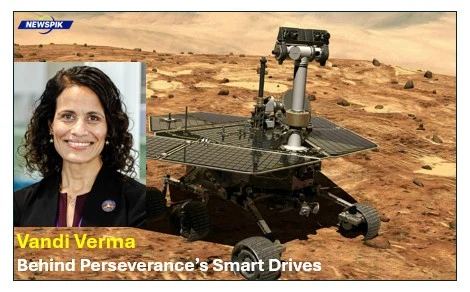

The Perseverance rover from NASA has made a big step forward by successfully finishing its first drives on Mars that were fully planned by AI. The robot didn’t need engineers on Earth to tell it what to do; instead, it used AI tools to look at the environment and choose its own path. With this new thing, Perseverance can move across Mars’ surface faster and go farther in less time.
The success of these smart drives is a significant step forward in our search for life in space. Communication between Earth and Mars can take anywhere from a few minutes to almost thirty minutes, which means that control cannot be done in real time. With artificial intelligence, the robot can now respond more quickly to its environment and make safer decisions independently.
Vandi Verma: Who is she?
Vandi Verma, a roboticist from India who works at NASA’s Jet Propulsion Laboratory, is at the center of this accomplishment. Verma was born in India and raised in Punjab. He developed an interest in science and technology at a young age. She later moved to the US to go to college and became an expert in robots and self-driving systems.
Verma has been a NASA rover driver since 2007 and is now one of the most skilled in the world. She has been an important part of many trips to Mars over the years, such as Spirit, Opportunity, Curiosity, and Perseverance. Helping robotic cars work safely and intelligently in tough and new places like Mars is what she does for a living.
How artificial intelligence helps the rover move
Perseverance’s AI-driven technology enables the rover to do three critical tasks. First, it lets the rover “see” its surroundings by identifying features such as hills, rocks, and other obstacles. Second, it helps the rover determine its exact location on Mars’s surface. Third, it plans and manages movement by selecting the most efficient route.
During the most recent smart runs, Perseverance analysed images and data from its onboard cameras and sensors to determine its route. This method reduces the rover’s need for regular orders from Earth and enables it to explore more of Mars each day. As a result, science can be done faster and the task is safer.
What This Means for Upcoming Space Trips
The future of space travel will likely depend on how well AI-powered guidance works on Mars. Humans have less control over projects that go farther into space because of the distance and the time it takes to communicate. Planets, moons, and comets far from Earth will need to be explored by systems that can work on their own.
The work of Vandi Verma demonstrates how artificial intelligence can support complex tasks in harsh environments. It also shows how Indian experts are increasingly important in space studies worldwide. As Perseverance continues its mission, AI-powered technology will become increasingly important for advancing our understanding of Mars and preparing for future missions that may one day include people.
SpaceX starts NASA’s Pandora mission to look for alien worlds far away

A versatile writer mainly works on trending news, daily updates from politics, business, crime, current affairs and entertainment.