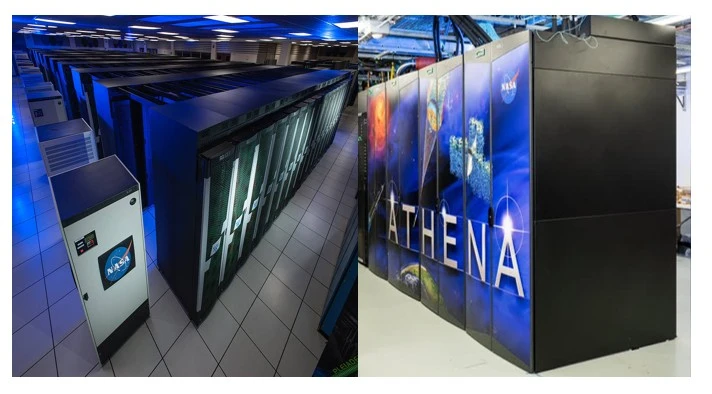

You’re doing science in the chillingly quiet, climate-controlled cubicles at NASA’s Ames Research Center here in Silicon Valley when suddenly a new titan rises. On Jan. 27, 2026, NASA unveiled a/ supercomputer it is calling Athena, its most powerful and “greenest” supercomputer yet. (Its name is for the Greek goddess of wisdom and war, who is in mythological tales Artemis’s half-sister.) This digital workhorse should be the “intellectual engine” behind a decade’s worth of deep-space exploration and Earth-science research.
Athena is also more than 20 petaflops faster than its predecessors Aitken and Pleiades. But more significantly, it heralds a new age of “green” high-performance computing: Providing tremendous processing capabilities and slashing the agency’s carbon footprint and utility costs.
What Makes Athena Different?
Athena is not just a scaled-up version of old technology; it fundamentally changes how NASA processes data. Athena, hosted in the agency’s Modular Supercomputing Facility (MSF), is containerized. This modular strategy enables NASA to gradually scale up its computing power, adding “blocks” of performance as mission demands increase.
Unmatched Processing Speed
Athena can carry out more than 20 quadrillion operations per second (20 petaflops). For perspective: If every person on the planet had been calculating one second at a time since the dawn of human civilization, it would take the global population nearly a month (calculated in real-time) to do what Athena does in one second. This velocity is important for modelling the turbulent physics of rocket launches or the intricate atmospheric dynamics of far off exoplanets.
Efficiency by Design
Supercomputers, as a class, are very well known for consuming power and generating heat. But Athena does something on its own; it’s using the light natural temperature climate that San Francisco bay area has. Instead of using huge, energy-devouring air conditioning units, the MSF utilizes sophisticated water cooling and outdoor air to keep its processors running at just the right temperatures. All that should help NASA achieve a Power Usage Effectiveness (PUE) rating of under 1.03, which is somewhere around the lowest in the world for any supercomputer running an actual workload.”
Educating the AI Workforce of Tomorrow
The most promising application for Athena is in AI. At this very moment, NASA is in the process of training gargantuan “Foundation Models”—artificial intelligence systems that can sift through decades’ worth of satellite imagery and telescope observations to look for patterns that human eyes may have never even thought to seek out.ENGINEERING Athena gives them the colossal real estate they need so they can train these models to spot cosmic oddities or watch ice caps melt or predict solar flares in ways not previously possible.
Fueling the Artemis Generation
Athena’s launch falls at no coincidence. With NASA gearing up for its Artemis II mission, the first crewed return to the lunar surface in more than half a century, that digital twin has become far more complicated.
Simulating Every Second of Flight
Before any fuel is burned, tens of millions of virtual launches are conducted by NASA engineers on Athena. They are simulations that take into consideration every variable imaginable: wind shear, atmospheric pressure and even the tiny thermal variations in the rocket’s hull as it transitions to empty space. By flying thousands of times this mission in a virtual environment like Athena, NASA can guarantee the very highest safety for its astronauts.
Designing Next-Gen Aircraft
Athena : Aeronautics Itself Beyond-space, Athena is Absolutely boon for Aeronautics. NASA’s current ”Sustainable Flight” efforts focus on electric and ultra-efficient wing designs. Testing such designs in conventional wind tunnels is costly and time-consuming. Athena enables the “Computational Fluid Dynamics” (CFD) tests that are so granular they can mimic the behaviour of an individual air molecule as it passes over a wing, removing years off the development cycle for greener commercial planes.
SpaceX starts NASA’s Pandora mission to look for alien worlds far away
From Earth Science to Exoplanets
Although Athena’s eyes are usually far off in the sky, its “brain” is tuned to our home planet. The supercomputer is a key resource for the Earth Science Division as its scientists work toward developing more precise climate models.
Tracking the Oceans: Athena processes data from a squadron of satellites, monitoring the health of the oceans, carbon cycles and rising sea levels.
The Search for Earth 2.0: The system is analyzing huge data sets from the James Webb Space Telescope (JWST) and the Transiting Exoplanet Survey Satellite (TESS). By studying the light signatures of remote stars, Athena assists scientists in determining which planets may have liquid water or breathable atmospheres.
“Exploration has constantly pushed NASA science forward to the boundary of what’s computationally feasible,” said Kevin Murphy, Chief Data Officer for Science at NASA. With Athena, we’re not just computing quicker, but smarter. This is the digital infrastructure for the next generation of discovery.”
The Democratization of Supercomputing
Its access is one of the most human aspects of the Athena launch. The system is a NASA asset, but the agency has made it available to outside researchers and partner universities. And by applying for “computing time,” researchers anywhere can put all that power to the test — there are global problems to solve, from vaccine research to earthquake modeling.
The very name “Athena” was selected in a contest among NASA’s own staff (in 2025), which indicates the culture of both big science and human competitiveness that it will include.
As NASA explores deeper into the solar system, the ability to process knowledge fast and efficiently will be the difference between success and failure of a mission. It’s Athena that makes it so, as our astronauts press on into the dark and staggeringly empty void, they do so with the mightiest light of human intelligence ever assembled in such force by a server rack at their backs.

A versatile writer mainly works on trending news, daily updates from politics, business, crime, current affairs and entertainment.