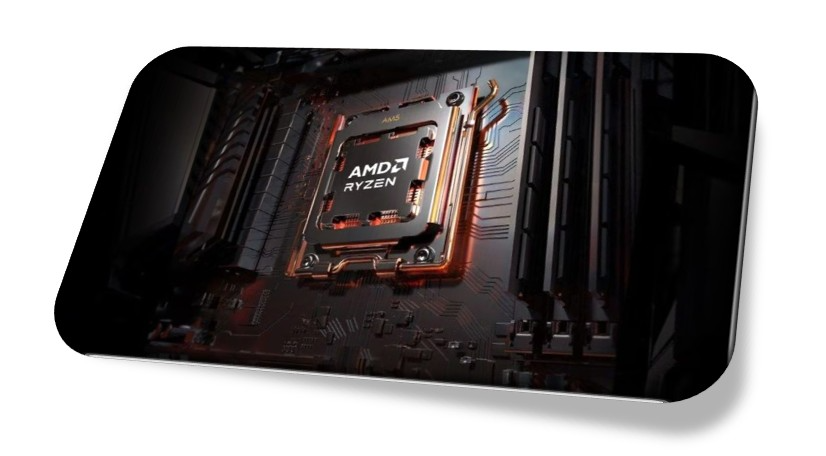

AMD has done it again. After dominating the custom gaming PC market with its previous X3D chips, the company is quietly confirming the existence of its next heir apparent: the Ryzen 7 9850X3D. Spotted in official AMD listings and shipping manifests, this new Zen 5 processor is poised to take the mantle as the definitive 8-core gaming CPU, offering a critical performance uplift over its already market-leading predecessor, the Ryzen 7 9800X3D.

For enthusiasts and custom PC builders, the arrival of the 9850X3D signifies a “golden sample” scenario—a highly refined chip designed to stretch the limits of the 3D V-Cache technology that has become AMD’s secret weapon against all competition.
The Magic of the X3D: Why Cache is King
To understand the hype around the 9850X3D, one must first appreciate the power of 3D V-Cache. In simple terms, this technology stacks an enormous amount of high-speed L3 cache memory directly onto the CPU die.
- The Gaming Advantage: Games, particularly CPU-intensive titles like simulators, MMOs, and competitive first-person shooters, constantly need to access large amounts of data. When the CPU has to fetch this data from slower system RAM, it creates a delay (latency) that leads to lower frame rates and stuttering. The X3D’s massive 96 MB L3 cache dramatically reduces these “cache misses,” ensuring the CPU always has the data it needs instantly.
- Performance Without Power Hikes: This architecture allows AMD to deliver frame rate superiority without needing the excessive clock speeds or power consumption of rival chips. The resulting processors are cooler, quieter, and more efficient.
Read also
The 9850X3D Upgrade: Speed Meets Cache
The Ryzen 7 9850X3D will retain the winning formula of 8 cores and 16 threads, paired with the crucial 96 MB of L3 V-Cache, all while maintaining a relatively low 120 W Thermal Design Power (TDP). The crucial difference lies in its clock speeds:
| Specification | Ryzen 7 9800X3D | Ryzen 7 9850X3D (Leaked) |
| Architecture | Zen 5 | Zen 5 |
| Cores/Threads | 8 / 16 | 8 / 16 |
| L3 Cache (Total) | 96 MB | 96 MB |
| Max Boost Clock | Up to 5.2 GHz | Up to 5.6 GHz |
| TDP | 120W | 120W |
The rumored 5.6 GHz Max Boost Clock represents a substantial 400 MHz increase over the 9800X3D. In gaming, the X3D cache has historically been the primary performance driver, but this significant clock speed bump—made possible by higher-quality “binned” Zen 5 dies and potentially a refined 2nd Generation V-Cache design—translates to tangible gains. Early benchmarks suggest the 9850X3D could be up to 5% faster than the already world-beating 9800X3D in both single and multi-core tests.
The Impact on the Custom PC Market
The confirmation of the 9850X3D signals that the AM5 platform remains the undisputed home for the ultimate gaming PC. For builders, this chip offers:
- Unrivaled Gaming Fidelity: It will be the single most efficient CPU for raw gaming frame rates, continuing AMD’s dominance in this specific metric.
- Seamless Upgrades: Since it utilizes the AM5 socket, it provides an immediate and powerful upgrade path for anyone currently running a less potent Ryzen 9000-series chip, or even those coming from older AM4 platforms.
- Efficiency: Maintaining the 120 W TDP means gamers won’t need to splurge on exorbitant cooling solutions or power supplies, keeping the total build cost lower than systems running power-hungry high-end chips from rival manufacturers.
The AMD Ryzen 7 9850X3D is anticipated to be officially announced at CES 2026 with a retail launch shortly thereafter. For gamers, this isn’t just another chip; it’s the next evolution of the architecture that fundamentally changed how we build the fastest gaming PCs.

I am a passionate content writer from the Chandigarh–Panchkula region. I am curious and love exploring diverse topics. At DailyBarta.in, I primarily write about video games and sports, bringing readers fresh insights, engaging analysis, and easy-to-understand breakdowns of the latest trends.