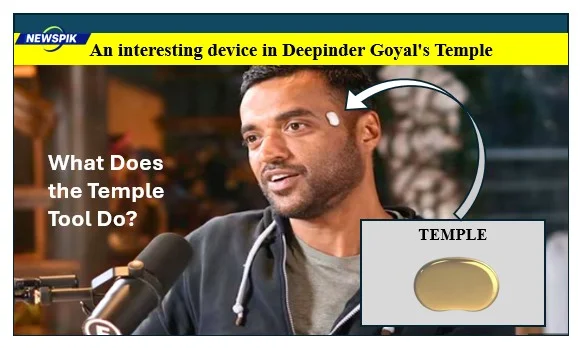

Deepinder Goyal, the founder and CEO of Zomato, recently got a lot of attention for a strange reason. During a radio interview, people saw a small metal object connected to his head. The video was immediately circulated on social media, and people began to wonder what the strange device was. Many people joked about what it was for, while others thought it might be some kind of future technology related to the brain or health.
Soon, the interest grew into a broader conversation when it became clear that the object in question is called Temple and is an experimental wearable that Goyal has been using and testing himself.
What Does the Temple Tool Do?
A portable monitor called the Temple device is meant to be worn near the temple area of the head. From what we know, it’s meant to monitor the brain’s blood flow in real time. Unlike most medical tests, which only record information about the brain at a single point in time, this device is designed to track changes over time.
Deepinder Goyal said that he has had the gadget on for more than a year. But he also made it clear that Temple is not yet a product for sale and is still in the testing and study stage. The public can’t buy it yet, and it hasn’t even been released yet.
Fed Up With Rule Breakers, Bengaluru Techie Builds AI Helmet
How the idea of gravity ageing came about
The Temple gadget is based on Goyal’s Gravity Ageing Hypothesis. This idea says that over many years, the steady pull of gravity may slowly cut off blood flow to the brain. People spend most of their lives standing or sitting up straight, so gravity could affect blood flow to the brain over time.
Goyal thinks that brain ageing may be caused by less blood flow. He wants to learn more about how aging affects the brain and to see whether early signs can be detected by continuously tracking blood flow. He says that the Temple device is a way to obtain this kind of information over a long period of time, rather than through short hospital tests.
Responses on social media and public interest
People on social media were both interested and amused by the video clip when it went viral. A lot of people made jokes about it, saying it looked like gum, a sticker or even a secret camera. Others thought it might have something to do with AI or brain control.
Even though it was made fun of, the gadget led to serious conversations about personal health tech and how tech leaders often try out new ideas in public. Many people are wondering how close this kind of technology is to becoming commonplace after seeing it on a famous businessman.
Google joins in on the ‘6-7’ trend. How to make your screen shake
Medical experts have concerns
Even though it got a lot of attention online, doctors aren’t sure if the gadget is real. People say that it’s hard to get a real reading of brain blood flow and usually needs current medical scans in a controlled setting.
Also, experts have said that any gadget used for health purposes must undergo proper clinical studies, peer reviewed studies, and government approval before it can be trusted. At this point, Temple has not been tested in this way, so doctors warn people not to consider it a proven health answer.
The device’s current state
The Temple device is still just a testing prototype for now. It’s not okay with health officials, and you can’t buy it in India or anywhere else. Deepinder Goyal has said that the project is still changing and is focusing on study rather than going into business right away.
The attention the device is getting shows that people are becoming more interested in health gadgets and brain monitoring tech. Experts agree that new ideas are good, but that these devices need to be backed by science and tested for safety before they can be used for medical or health purposes.

I am a versatile content writer from the MP region, covering politics, business, crime, current affairs, entertainment, video games, and sports with clear insights, engaging analysis, and timely, reader-focused updates.