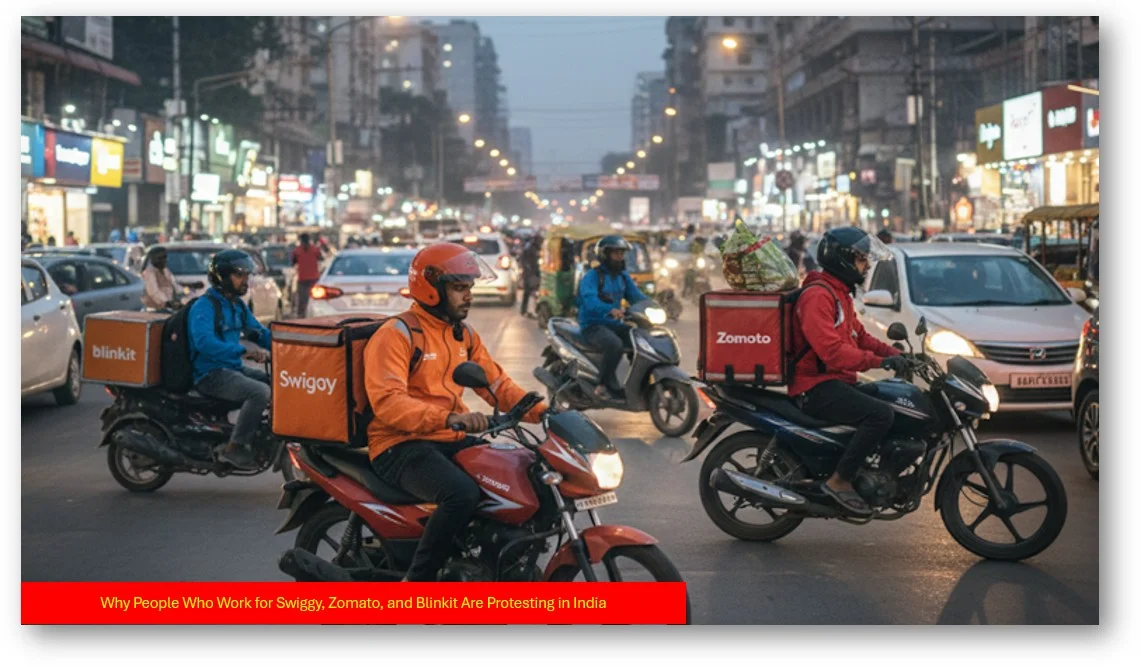

Delivery drivers for popular food and fast–food apps like Swiggy, Zomato and Blinkit have gone on strike across the country to protest low pay and bad working conditions. In several Indian towns, the protest has brought new attention to the problems job workers face. These workers are essential to the country’s fast-growing transport economy.
As the strike goes on, workers say that rising prices, long hours, and a lack of job security have made it harder for them to make a living. The protest’s goal is to get companies and lawmakers to listen to their concerns and improve conditions for transportation partners.
What Caused the All-India Strike?
After months of rising anger among delivery workers, the strike was called. Many workers say recent changes to their pay have made them earn less, even as gas prices, car repair costs, and other daily expenses keep rising.
Partners in delivery say bonuses have been cut and their base pay per order has decreased. People have to stay online longer hours to make a basic income because of this. Some workers say they are punished when they are late or cancel an order, even if the delay is due to something they couldn’t control, like traffic or a restaurant taking too long.
Workers also say that app formulas decide how much work they have to do and how much money they make, leaving them with little information or control.
What Delivery Workers Need to Do
The workers who are striking have made a list of requests. It is important that there is a set minimum hourly wage and an assured minimum pay per delivery. Workers say this is needed to protect them from uncertain order amounts and keep their wages fixed.
Cutting down on long work hours is another big demand. A lot of delivery partners say they have to work 12 to 15 hours a day just to make enough money to pay their bills. They are asking for fair pay for extra and sensible work limits.
Workers also want health insurance, accident insurance, and social security payments. They say that transport work on the roads is very dangerous, so protection should be required and provided by the platforms.
Delivery workers also want to know how rewards and punishments are figured out and have a fair way to file complaints.
Effects on Services and How People Respond
In a number of places, the strike has made it harder to get food delivered and buy things quickly. Customers have said that deliveries are late and hard to get during busy times. In some places, services were temporarily halted because many workers didn’t come to work to take part in the protest.
The public has had a range of reactions. A lot of customers spoke out in support of the workers, saying that safety and fair pay should come first. Others were worried about service interruptions, but they agreed that the workers’ requests show that the gig economy has major problems.
Activists and labour rights groups have also backed the strike and called for stricter labour rules to protect gig and platform workers.
It’s hard for the gig economy
Millions of people work in India’s gig economy on sites for food delivery, ride-hailing, and quick shopping. Some people say that because these jobs aren’t official, workers don’t get fundamental rights like minimum pay, paid leave, or retirement benefits, even though they give workers a lot of freedom.
As platform-based work grows, experts say that rules need to change to ensure it is fair and lasts. Long hours and not knowing how much money you’ll make could cause more stress, safety risks, and worker burnout if nothing is done to fix the problem.
The current strike shows how angry delivery workers are getting and how business, workers, and the government need to talk to each other.
What’s to Come
As the strike continues, workers hope their demands will lead to real changes rather than just short-term promises. In the next few days, people are likely to talk more about fair pay, social security, and workers’ rights.
The protest could impact India’s gig economy and how millions of workers are treated in a future where jobs are becoming increasingly digital.

A versatile writer mainly works on trending news, daily updates from politics, business, crime, current affairs and entertainment.