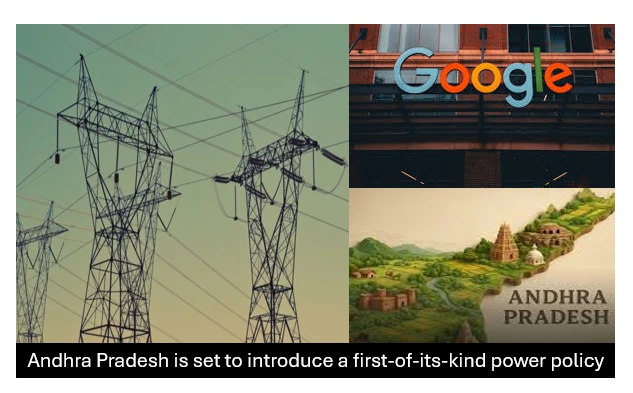

Through buy deals, a new strategy will enable private companies to get energy directly from power-generating companies. This will make them less reliant on state services.
The government of Andhra Pradesh is going to make a rule that will let private companies that need more than 300 megawatts (MW) of power apply for a discom license. Senior officials have told us about this.
While the strategy is still being worked out, Andhra Pradesh will be the first state to issue discom licenses to private companies not in the power business.
As their energy needs continue to grow, IT, pharmaceutical, and steel businesses in the state have been pushing for discom licenses to secure stable, reliable power.
Private companies can buy energy directly from electricity generators under power purchase agreements if they have a discom license. This will make them less reliant on government services.
This strategy will also help big data center companies and partnerships grow in Andhra Pradesh. Examples include Adani and Google, Brookfield and Reliance, and Meta and Sify Technologies.
Framework for licensing
The last part of the power production line is the discom, or delivery company. The Electricity Act, 2003, says that the Ministry of Power is in charge of licensing discoms. It sets rules for things like having enough cash, being creditworthy, and following certain rules of behaviour. In this case, licenses are given out by the Central Electricity Regulatory Commission and the State Electricity Regulatory Commissions.
The rules are often changed, most recently with the Electricity (Amendment) Bill, 2025, to make it easier for new companies to join the distribution industry, let companies share networks, and encourage competition.
About 80% of all discom licenses in India are owned by companies that are owned by the government. Private power producers, like Tata Power, have also been given permission to distribute energy in some places.
The three state-owned discoms in Andhra Pradesh are the AP Central Power Distribution Company Ltd, the AP Eastern Power Distribution Company Ltd, and the AP Southern Power Distribution Company Ltd.
Officials say that after the power company is privatised, the state commission will still set the minimum and maximum prices for selling electricity to consumers in places where there are more than one discom.
Read also: Andhra cabinet approves marginal hike in liquor prices
Responses from the business
Industry groups have praised the government’s policy, and private power companies and original equipment makers (OEMs) have asked other states to do the same.
K. Jayarama, founder and COO of Vantageo, an OEM that focuses on IT infrastructure and server solutions, told ThePrint, “The AI era has completely changed how power is used.”
India’s data center economy is expected to grow to 10 gigawatts (GW) by 2030
As a result, Jayarama said, the country will need four times as much water and electricity. It takes the same amount of power and 1.5 times as much water, or 150 billion litres, to run a one-GW data center.
It was agreed upon by Vikram Redlapalli, CEO of RDP India, which sets up AI infrastructure for data centers. He said that states could be more aggressive in their plans to increase power production.
“Data center, or AI, is the new oil,” Redlapalli told ThePrint. We are all moving into the era of tokens or AI, which is just another name for the era of intelligence. Power is one of the most important parts of AI systems. Countries that can figure out how to make and give power will be in charge of the AI growth wave.
Read also: Credai: B’luru remains largest apartment market in K’taka
What AI models need to do
It is the job of the International Energy Agency to help countries around the world meet their energy needs. In a study about AI energy demand, the agency said, “By 2030, global data center electricity consumption is expected to double to reach around 945 TWh.”
“From 2024 to 2030, the amount of electricity used by data centers increased by about 15% per year, which was more than four times faster than the growth in all other sectors’ electricity use.” As AI becomes more popular, more high-performance accelerated computers are being put into use faster. This makes data centers more power dense. The study said, “Knowing how fast and how many accelerators are being used is very important because it will have a big impact on future electricity demand.”
To show how much power is needed, Redlapalli said that Elon Musk and Microsoft are exploring space and underwater data centers as ways to address AI models’ huge power and water requirements.
“States will need to think about more than just transmission when it comes to the power supply chain.” To get the power they need, countries all over the world are approving plans to build nuclear plants inside data center complexes.
Amazon, Alphabet, Meta, and Microsoft are expected to spend close to or more than $700 billion on AI-related projects by 2026. Redlapalli stressed that India needs to build up its AI infrastructure as quickly as possible.
Redlapalli did warn, though, that power licenses will need to be closely controlled and watched, just like booze licenses.

A versatile writer mainly works on trending news, daily updates from politics, business, crime, current affairs and entertainment.