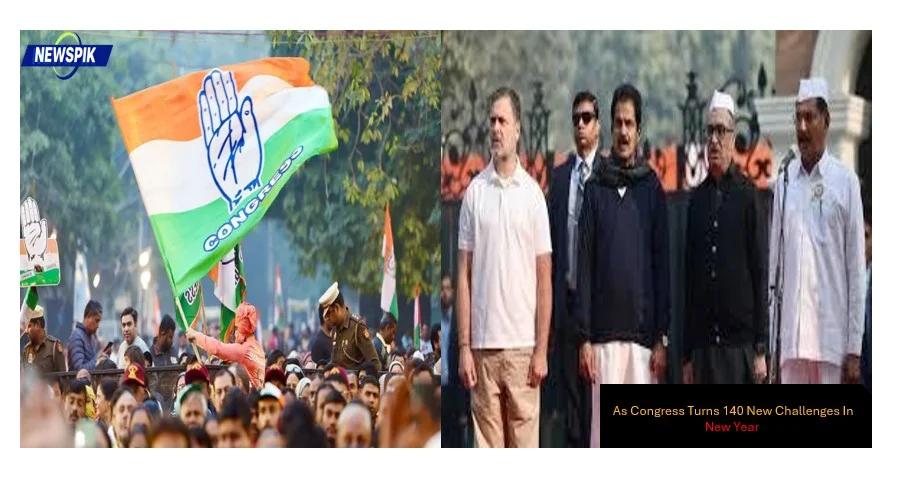

On December 28, 2025, the Indian National Congress (INC), completed its one hundred and fortieth year of existence. Born in 1885 in a small hall in Mumbai, the party that led India to independence finds itself at a historic crossroads. On the day his “Grand Old Party” blew out birthday candles, at the Indira Bhawan headquarters it was a mix of solemn reflection and high-octane poll strategy.
The momentum, which was revitalized by the 2024 Lok Sabha elections — reinstating the party’s seat tally to nearly triple digits — has hit a rather rickety patch over the second half of 2025. And now, in 2026, the Congress leadership, including Mallikarjun Kharge and Rahul Gandhi is getting itself for a do or die year that will stretch the party’s organizational grit, ideological clarity and more.
A Road Map for 2026: A War on Five Fronts
In early 2026, five big regions — Assam, Kerala, West Bengal, Tamil Nadu and Puducherry will be going to polls. These elections are about more than seats to the Congress; they’re about demonstrating that the party can still govern.
The Kerala Litmus Test: In Kerala, the Congress-led UDF is locked in a bitter contest with the ruling Left Front. The left shattered that pattern in the last cycle after “alternating” power for decades. A defeat here would amount to a devastating body blow for the primary political base of Rahul Gandhi.
The Assam Reclamation: The party is endeavouring to pin down Chief Minister Himanta Biswa Sarma on the question of corruption and social justice under the rising leadership of Gaurav Gogoi.
The Alliance Tightrope In Tamil Nadu, where the Congress is still a junior partner of the DMK. Though, murmurs in the party have been about asserting independence increasingly and more so with new political kids like Vijay, an actor turned politician entering the arena.
Tejashwi Yadav is now the undisputed leader of the Mahagathbandhan ahead
Ideology vs. Organization: The Inward Fight
Although the party has been successful in refocusing its narrative on the plank of “Social Justice” (Samajik Nyay) and Constitution protection, yet another familiar ghost seems to be returning to hunt the grand old Sonia-Rahul-led party which is organisational inviability.
Senior leaders like Digvijaya Singh and Shashi Tharoor did not mince words in their 140th Foundation Day speeches. They stressed that although the party has its heart in place, but “muscles”-the grassroots booth-level workers-need an urgent strengthening.
The Congress cannot be built by offering floral tributes, a senior leader said. “The heritage, which is 140 years old, can only be respected when we reach people with our ideology at a local level, one house by one.”
Key Organizational Challenges for 2026:
The Youth Quota: For the 2026 organizational positions and ticket distribution, the party has announced a promise of fifty percent youth (and women) representation—a risky bet that may estrange the “old guard.”
District Revitalization: A new effort to replace DPIP with energetic, proactive district presidents from around the country will be completed by early 2026.
The Priyanka Factor: The demand is growing for Priyanka Gandhi Vadra to play a more formal, high-intensity part in connecting the leadership to the people.
The ‘G RAM G’ Act: New Lightning Rod
The start of the new year has made clear what the Congress party’s legislative prime target is: The GRAMG Act, which has become the government’s new and contentious replacement for an erstwhile MNREGA scheme. The party considers the repeal of two-decade-old rural employment guarantee as an “insult to Mahatma Gandhi” and a blow to the rural poor.
The Congress Working Committee (CWC) has already approved a countrywide movement on the lines of 2021 farmers’ protests. And by focusing on rural distress as its central theme for 2026, the party hopes to connect with a voter base that has increasingly felt left behind by the breakneck pace by which the digital economy has grown.
Final Thoughts: The Soul Of The Nation
As Rahul Gandhi declared at the flag-hoisting, Congress sees itself not only as a political party but rather as ‘voice of India’s soul’. But in the dog-eat-dog world of 2026 politics, a soul is only half the battle; a winning strategy is the other.
The next year will tell whether the 140th was a salute to a splendid past and a resurgent future. The “Grand Old Party” is no longer just battling for seats; it is fighting for relevance in a fast-changing India.

A versatile writer mainly works on trending news, daily updates from politics, business, crime, current affairs and entertainment.