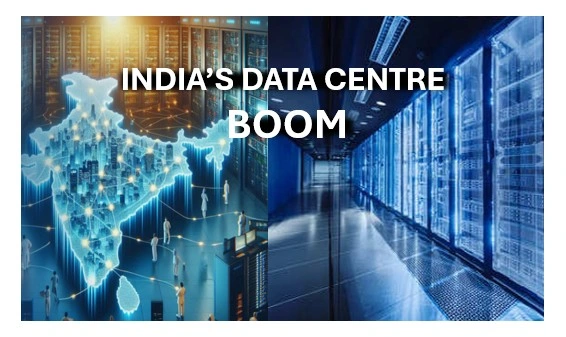

The digital revolution is usually discussed in hypothetical terms we discuss the cloud like it is in a vacuum, our photos, bank transactions, and binge-watching streaming shows are in a vacuum in a weightless vacuum. However, when you go to the periphery of Navi Mumbai, Noida, or Chennai, then you will discover that this cloud has a very heavy, very physical anchor. It consists of concrete reinforced and miles of copper wiring and the incessant whirr of industrial cooling fans.
India is going through an unannounced structural metamorphosis. The future of real estate is not luxurious apartments or shopping malls but the data centre as the country transitions to a trillion-dollar digital economy.
The Corporeality of an Electronic Fantasy
It is necessary to peep behind the blazing blue lights of a server rack to see the nuts and bolts of this boom. The creation of a data centre is an enormous engineering endeavour. It is a Herculean task to have thousands of high-performance processors melt down in a country where the ambient temperature tends to exceed 40 o C.
This has given rise to a new dawn of Green engineering in India. The old way of air cooling is being replaced with Liquid Immersion Cooling whereby the servers are immersed in the synthetic oils so that they cool better. It reads as science fiction, yet to engineers who earn their living at the plant in Hyderabad or Bengaluru it is the mundane task of making sure that a billion UPI transactions are made with not even a glitch.
Read also: AI boom will produce victors and carnage, tech boss warns
Data Sovereignty: Pushing the “Cloud” Home
Decades worth of data in India have been stored in cold, underground tunnels in Virginia or Singapore. This was transformed by a complete turnaround of policy and attitude. This construction frenzy has been majorly triggered by the push of Data Localization, which is a concept that the data of an Indian citizen must be on Indian soil.
This change is very humanizing as far as the stakes are considered. When a farmer in Maharashtra opens an app on his phone that allows him to see his crop insurance or a student in a far flung village in Odisha opens a digital library, he or she does not need the data to land half the world away anymore. It stays local. This lessens the latency- the minute delays that may create and shatter a digital experience. Even in the high-frequency trading or robotic surgery business, it is not a matter of milliseconds of technical measurement: it is money or lives.
Read more: The Digital Harvest: Why Farm Data Privacy is the New Frontier in 2026
Power and Fiber Infrastructure Backbone
Food and drink to a data centre are umbilical cords and this is all that a data centre can be. The boom has two vital components, which are the nuts and bolts:
- The Power Grid: Data centres consumes power centres. The fashion in 2026 is the captive renewable plant. Large operators such as Adani Connex and NTT are tying their plants to the huge solar and wind farms. This is so that the servers can be hot but the carbon footprint is cold.
- Fiber Connectivity: There is a subsea cables junction known as Spaghetti Junction under our feet, coming ashore on the coast of India. Chennai and Mumbai have turned into the Marseille of the East, the points of entry of huge high-speed cables, which connect India to the Middle East, Europe, and Southeast Asia.

I am a versatile content writer from the MP region, covering politics, business, crime, current affairs, entertainment, video games, and sports with clear insights, engaging analysis, and timely, reader-focused updates.