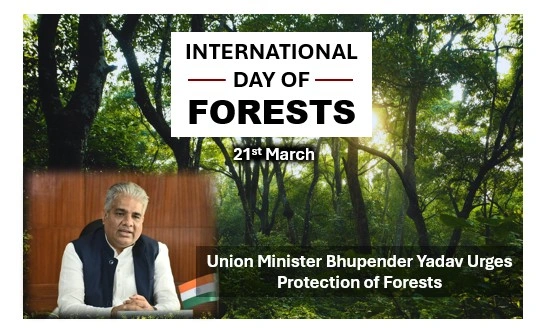

It is mostly referred to as the lungs of the earth due to the sound made by the leaves of a thick canopy, yet to the Union Minister Bhupender Yadav, the sound of the rustling leaves represents the pulse of the future India. The Minister gave an impassioned call to arms on March 21, 2026, at the time when the world was reflecting the International Day of Forests, and cut through the policy language to the people themselves, their need to stay alive.
In global theme 2026, the sub-title, Forest and Economies, Yadav pointed out that the well being of our woodlands is not merely a measure of the environment- it is the foundation of our national successes.
Human Connection: Why We Protect
In a speech at one of the occasions marking the event, Yadav kept in mind that to millions of Indians a forest is not merely a group of trees but it is a home, a drugstore, and a refuge. Conservation is an intensely human activity, between the tribal people of Chhattisgarh, who use the forest floor as their own, special purpose courtyard, and our own growing Ramsar sites with their protectors, the Wetland Mitras.
The Minister commented on the subject by saying that sustainability is not something to want to achieve but a way of life. He gave us a picture of India whereby our emerald heritage is not sacrificed in the name of economic growth. Combining the ancient experience of forest dwellers with scientific knowledge, the government wants to form a so-called Janbhagidari movement (people participation) that will transform every citizen into a green guardian.
A Legacy of Growth: Green Footprint of India
These figures give an account of silent, patient strength. The forest and tree cover of India according to the latest estimations has hit 25.17% of the geographical area in the country. Although the trend around the world is usually on the direction of depleting, India has been contrarian, and it has always performed well in the top three countries in terms of net annual forest gain.
India: Critical Turning Points of Conservation:
- Growth of Carbon Sinks: India has become the 5th largest in the globe, with the forests of the country absorbing approximately 150 million tonnes of CO2 annually.
- Expansion of Ramsar Sites: Since Yadav took office, the number of sites that are under protection has experienced a boom to 98 sites which guarantees that the kidneys of the landscape are still very active and alive.
- Mission LiFE and Ek Ped Maa Ke Naam: These are flagship campaigns which have humanized the action on climate by asking people to plant trees in the name of their mothers by connecting their emotional heritage with their responsibilities to the environment.
Read more: International Day of Forests: Protecting the Lungs of Our Planet
Forests: the Future Economic Engine
The 2026 theme of Forests and Economies is an aspect that brings a pivotal change in world thought. Forests are no longer perceived as some no-go zones but as living elements of a sustainable bioeconomy. Yadav pointed out that forests provide livelihood to a population of more than 1.6 billion people in the world since they supply them with almost everything namely timber and non-wood survival such as honey, resins, and even medicine herbs.
This economic connection in India is being enhanced with the National Mission to a Green India that is planning to increase forest cover to 5 million hectares. This is not only planting saplings, but it is about providing employment opportunities in eco-tourism and sustainable harvesting as well as carbon credit markets.
Also read: World Wildlife Day 2026: Protecting Nature, Preserving Life
Challenges on the Horizon
Though it has come this far, there is still a long way to go. The Minister was not afraid of the ugly facts of climate change wildfires, outbreaks of pests, and the stress of high urbanization. He mentioned that we are celebrating gains but we have to deal with the forest disturbance notices that are occasionally rotating through our satellite TV screens.
The 2026 strategy is based on a Whole-of-Government strategy. This involves the growth of the International Big Cat Alliance and reintroduction of Cheetahs to Kuno and Gandhisagar which proved that forest health is indivisibly connected with the survival of apex predators.

A versatile writer mainly works on trending news, daily updates from politics, business, crime, current affairs and entertainment.