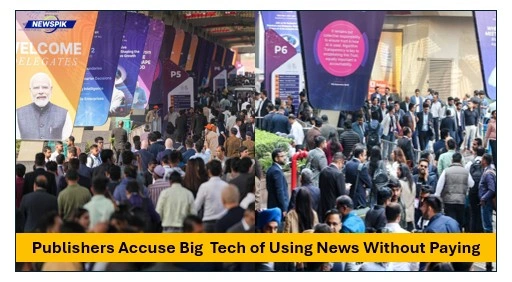

Bharat Mandapam, New Delhi The halls of Bharat Mandapam in New Delhi, where handshakes are exchanged at the highest levels of diplomacy, is transformed into a mini battlefield on February 16, 2026. At the India AI Impact Summit, talk about the marvels in algorithms evolved into cold, hard economics of survival.
The report from India’s biggest news publishers — the people who built called the country’s “democratic infrastructure” — was unquine and scathing: Big Tech is eating our lunch, they said, and they are not going to feed us.
As generative AI models like ChatGPT and Gemini come to be the primary source of people’s consumption for information, it will break the traditional “click-and-referral” model of internet. Indian media tycoons are now cautioning that if the “extractive” relationship between tech and journalism isn’t addressed, the very truth that powers these AI models will soon dry up.
Journalism is No Junk: The DNPA Charter
At the helm was Digital News Publishers Association (DNPA), which comprises India’s most powerful newsrooms. In a power panel ‘AI and Media: Opportunities, responsible pathways and road ahead’, personalities like Kalli Purie (India Today Group), Mohit Jain (Times of India) and LV Navaneeth (The Hindu) put forward potent arguments in defence of their intellectual property.
Kalli Purie introduced 9 Point Charter to reorder the power ratio. Her central metaphor was sharp: Journalism isn’t “scrap metal” or “raw material” to be poured into a machine at no cost.
The Investment Gap: Publishers contended that, whereas AI companies scrape data in milliseconds, the data they use is built on investments in ground reporting, editorial oversight and legal risk-taking.
The crisis of accountability: So unlike AI models that can “hallucinate” or provide an anonymised summary, news brands are legally and ethically accountable for every word they publish. The use of this “accountability” to train an unaccountable bot is, they argue, a theft of value.
The Traffic Cliff: Why 2026 Is the Tipping Point
The paranoia at the top was not theoretical: It was rooted in “Search Zero.”
Historically, search engines functioned as a pass-through, directing traffic to the publisher. But AI-generated summaries (such as those made by Google’s AI Overviews) currently give the answer right on the search page.
The result? A “traffic cliff.”
Publishers are getting 40 percent less traffic from the site. If the user gets a 200-word summary of an investigative report that’s 2,000 words long, they never click. The publisher forfeits the ad revenue, subscription potential and brand recognition while the AI platform captures their attention and data.
“If journalism fuels the accuracy of AI systems, proper credit and compensation must be given for that value,” commented Robert Whitehead at the International News Media Association (INMA).
The “AI Sandwich” framework: putting humans first
For all the bad blood, publishers aren’t Luddites. They’re also putting artificial intelligence to use — just on their own terms. Kalli Purie came up with the idea of the “AI Sandwich” — a framework that retains humans in control.
- The Top Layer (Human): Human motivation and casual enquiry kick off the story.
- The Middle Layer (AI): AI helps with data crunching, transcription and formatting.
- Bottom Layer (Human): An editor, the final arbiter of ethics, accuracy and tone.
The rationale behind this framework is a simple one: the current levels of rubbish slopping into the internet — AI Slop, crappy, automated content that undermines good work — are making it increasingly hard for quality news to remain front-and-center in people’s lives.
AI Impact Summit 2026 Live Updates: From Job Disruption To Child
Conclusion: The Specter of “Information Poverty”
The India AI Summit 2026 has been a wake-up call — we are there. If Big Tech enjoys feasting on the news without sowing more seeds, the ecosystem will go extinct. The ways we “understand” an event are subject to myriad influences, they do not proceed in every case from the same prima facie facts and logic, yet AI models rely on these; for example: They miss the drug dealer a mile off because he’s wearing shades. 2) AI trained from the toxic data of a dead web will become more and more inaccurate (and therefore biased).
As India forges a path to become a global AI leader, the government’s obvious challenge is that the “AI Impact” should not turn out to be free press’ extinction.

I am a versatile content writer from the MP region, covering politics, business, crime, current affairs, entertainment, video games, and sports with clear insights, engaging analysis, and timely, reader-focused updates.