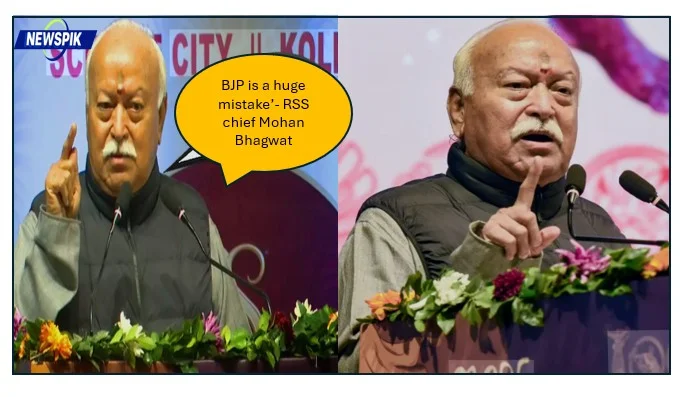

Rashtriya Swayamsevak Sangh (RSS) leader Mohan Bhagwat on Friday claimed that attempting to know the organisation through the prism of the Bharatiya Janata Party (BJP) would be a massive error. At a meeting in Bhopal on the 100th anniversary of the RSS, Bhagwat said that the Sangh was not formed to be a response or opposition to a political group, and it was a unique socio-cultural organisation with ideology, purpose, and discipline of its own.
Bhagwat will visit various places within Madhya Pradesh on the occasion of programmes to celebrate 100 years of the formation of the Sangh. To cover swayamsevaks and invitees, he emphasized the fact that the RSS, commonly related to its political descendants, is commonly misinterpreted due to individuals using partial or one-sided sources of information.
RSS is not the BJP, and it will not be comprehended through politics
It is important to note that Bhagwat stressed that the RSS could not be compared to the BJP or any of the related organisations. It would be a mistake of huge proportions to look at the BJP and draw conclusions about the Sangh. This is the same error you will commit when you attempt to comprehend it by referring to Vidya Bharti, he said.
He has mentioned that although there is ideological closeness between the RSS and its affiliate groups, such as the BJP, the two operate in mutually exclusive fields. The Sangh, he explained, is concerned with the construction of society, discipline, and cultural unity, whereas political parties operate through an electoral system and rule.
President Murmu Celebrates Tribal Heritage at Gumla’s Kartik Jatra
RSS is not a paramilitary organisation
Owing to the old perception that the RSS is a militarised force because of its drills, marches, and uniforms, Bhagwat explained that these are all part of its training programme to instill discipline and unity. We have a uniform, we put out marches and stick drills. However, if an individual believes that it is a paramilitary organisation, then he or she will be mistaken, he said.
He further stated that the Sangh is committed to the cause of establishing national character, enhancing social cohesion, and that India would never ever again be under the grip of a foreign domination. In his view, the organisation’s operations are directed towards developing values, responsibility, and patriotism among citizens.
False stories were being disseminated
Bhagwat was also talking about the common misunderstandings about the RSS, and he was accusing people of superficial consumption of information today. In the modern world, individuals no longer delve to collect the correct data. They do not go to the origin. They go to Wikipedia. Everything is not so there, he said.
He encouraged those who were wondering about the RSS to find out the actual information via reputed sources rather than narrative hearsay, social media, or politically inclined commentary. He claimed that the misunderstandings had necessitated his touring the country and meeting people across the country during the centenary year as a way of clarifying the true meaning of the Sangh.
RSS was not conceived as a response and reaction
Ruling out the idea that the RSS was a counter-movement against any other political or ideological activism, Bhagwat stated that the Sangh is not a reactionary or oppositional movement. It is a shared sentiment that the Sangh was an attempt or a response to the dominant powers. This is not the case. The Sangh is not a response or protest against something. Competition is also an impossibility with the Sangh, he told himself.
He restated that the RSS is based on the Indian ethos of civilisation and is intended to bring together the society across caste, class, language, and regional differences.
Swadeshi and self-reliance
In his speech, Bhagwat also gave great focus on Swadeshi and economic self-reliance. It is only when the people of India build up a sense of self-pride, Atma Gaurav, that India can be well-known as Atmanirbhar (self-reliant).
He advised everyone only to buy and use goods produced in their country, and that being Swadeshi does not mean being an isolator. He said that imports should be limited to necessities, including medicines not manufactured in India. He emphasized that the national interest of India had to be the factor that informed their trade decisions and not external coercion or fear of tariffs.

A versatile writer mainly works on trending news, daily updates from politics, business, crime, current affairs and entertainment.









