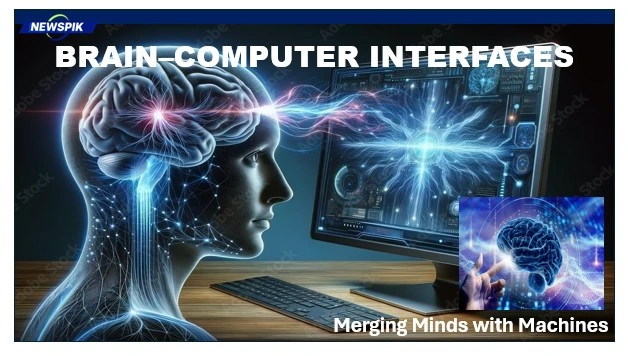

Brain-computer interfaces (BCIs) occupy the intriguing intersection of the realms of neuroscience and engineering and the realms of imagination and science fiction. Science fiction ideas such as controlling machines with the brain and telepathic communication have become reality with the help of brain-computer interfaces. However, the difference between the current capability of science and the promises of science fiction remains quite broad and a brief understanding of that difference will help to better comprehend the significance of this revolutionary area of research and development.
What Are Brain-Computer Interfaces?
A brain-computer interface is a technology that connects the brain and other devices like computers directly, without using any of the normal methods of communication, such as muscles and nerves. BCIs function in a manner where the signals in the brain are decoded and the signals are converted into commands for computers and other machines.
BCIs can either be invasive, which requires the implantation of electrodes directly into the brain, or noninvasive, with methods like electroencephalography being used to detect brain activity by using the scalp. While noninvasive methods are less accurate, they are safer and easier to implement compared to invasive methods, which are more precise.
The Science We Have Today
Today, BCIs are already showing their effectiveness, especially in the field of medicine. Just one of its most successful uses is in helping paraplegic patients regain their motor functions. Patients have been able to control robotic arms, type messages, and even operate their wheelchairs using their BCIs. Another of its successful applications is in cochlear implants, where hearing can be regained by stimulating the auditory nerve directly, considered one of its earliest applications.
In neuroscience studies, BCI systems make it possible to better understand brain-encoded representation of movement, sensory input, and intentions. Today, machine learning algorithms are able to decode brain signals correctly to make it possible to control external devices in a smooth and intuitive manner.
However, such systems require heavy training. Moreover, they can function in a controlled environment. It is pertinent to note that even the best BCIs available in modern times can recognize no more than narrow patterns in neural patterns.
BlueBird Block-2 mission: ISRO successfully launches LVM3-M6 rocket
Where the Limitations Lie?
Though there has been immense progress, there are numerous scientific and technical hurdles that BCIs are facing. The human brain is incredibly complex and consists of neurons that are all working in unison. The current state-of-the-art systems are not able to pick up anything more than a fraction of that signal. There are noise levels, implant stability, and rewiring by the brain with time that makes it difficult for decoding.
Non-invasive BCIs, though safer, face problems of low resolution and disturbances caused by the skull and scalp tissues. Invasive BCIs face problems related to surgery and alterations in brain tissue in the long term.
However, it is probable that the major constraint is interpretation. Neural activity is not directly translatable into thoughts such as language, memories, and intentions. Correlated patterns to specific tasks and not direct thoughts are what exist.
The Sci-Fi Vision of BCIs
Science fiction commonly shows BCIs as a smooth interface between human intelligence and technology: instant knowledge transfer from human brains to computers, mind-to-mind conversations, or full immersion in virtual realities. Characters control devices like appendages, discuss ideas effortlessly, or boost intelligence at will.
Although admirable, these visions require a sophistication that has not yet been achieved in the understanding of the mind and the technology necessary for their fulfillment. “Mind reading” and the ability to transfer consciousness through “downloading” do not accurately describe the functioning of the mind and the way in which thought is distributed in the mind.
Nevertheless, sci-fi also has a significant role as it presses scientists to think about possibilities that lie beyond the existing boundaries.
Ethical and Social Questions
As BCIs continue to develop, questions of ethics become more and more relevant. For example, “Who owns the data generated by our brains?” “How can we protect the privacy of our thought-controlled machines when our thoughts can control machines?” “Are we headed for a divided world, where cognitive enhancements are available mainly to the elite?”
There are also concerns in relation to autonomy and identity. Where does human autonomy stop and technology start when it is possible for a machine to interact directly with activities in the brain, as is currently possible in certain types of BCI therapeutics?
Artist Reimagines Billionaires as Robot Dogs in Bold New Installation
Bridging Reality and Imagination
Current BCIs are technological power tools, not magical mind-reading tools. The science stops at understanding how to decode weak neural signals for particular tasks, and the sci-fi world is where we hope for easy, general intersection between brains and machines.
The future of BCIs promises to be one that will unfold in an evolutionary, and not revolutionary, fashion—a gradual, incremental process that will see improvements in accuracy, safety, and ease of use, as opposed to the development of some fantastic, science-fiction-inspired gadgetry. And it’s in being grounded in scientific reality while keeping our imagination engaged that we can best navigate the possibilities that lie ahead.

I am a versatile content writer from the MP region, covering politics, business, crime, current affairs, entertainment, video games, and sports with clear insights, engaging analysis, and timely, reader-focused updates.