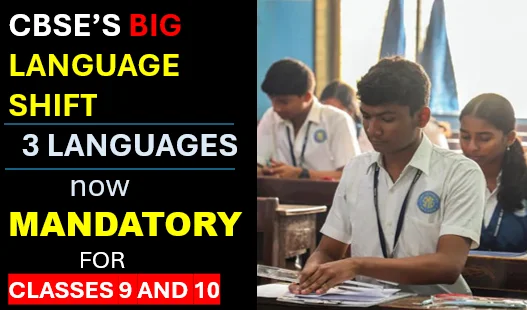

The Central Board of Secondary Education has made a major change to how it runs its schools. This change will have a direct effect on lakhs of students all over India. Students in Classes 9 and 10 will have to learn three languages starting July 1, 2026. This is because the curriculum is being changed.
In line with the National Education Policy (NEP) 2020 and the National Curriculum Framework for School Education (NCF-SE) 2023, the choice was made. Under the new plan, kids will learn three languages, which will be called R1, R2, and R3. At least two of these must be Indian languages.
Class 10 doesn’t have a board exam for a third language
CBSE has made it clear that there will be no Class 10 board test for the third language, also known as R3. This is great news for pupils. Instead, this language will still be graded at school and by people inside the school.
The board says this was done so that students can focus on learning the language and not feel like they have to worry about another board subject. The move should also make students less stressed about tests while still pushing them to learn more than one language.
You can still choose a foreign language if you want to, but only if the other two languages you choose are Indian. In some schools, foreign languages may also be taught as a fourth language.
Why CBSE Made the Thre Language Formula Available
The new rule fits in well with NEP 2020’s goals, which strongly support teaching in more than one language and using Indian languages in schools. The strategy is meant to help kids communicate better, understand other cultures better, and grow intellectually.
Experts in education say that knowing more than one language can help students do better in India, which is a very different country. The new system should also make students more likely to keep up with their native and area languages.
CBSE says that under the new system, learning a language will not only be about reading and writing, but also about speaking, listening, reading, and writing for real life situations. Reports say that the third language curriculum might stay less rigorous than the major languages so that students can find it easier to learn.
Read also: Union Education Minister Dharmendra Pradhan addresses the need for international collaboration
Schools are given time and freedom to make the change
To make the change go more smoothly, CBSE has let schools make temporary plans for the first few weeks of implementation. The board agreed that it might be hard for many schools to find suitable teachers who can teach more than one Indian language.
As an option, schools can share teachers between schools, offer online or mixed help for teachers, or even hire former language teachers. CBSE also said that textbooks for third language classes for Class 6 students in 19 official Indian languages will be ready before July 2026.
During the 2026–27 school year, students in Class 9 may use language books from Class 6 until they are given their own books. Also, schools have been told to use songs, stories, and writings from the area to help students learn the language better. Soon, there will likely be more detailed training standards available.
Responses from students and parents were mixed
Online users have had a range of responses to the news. Some parents and students are happy about the choice because they think it will help keep Indian languages alive and make interactions better. Others, on the other hand, are concerned that making another language mandatory could make schoolwork more difficult.
Many schools already use some form of a three language system up to middle school, as seen in conversations on student boards and social media sites. But adding Classes 9 and 10 is seen as a big change.
A lot of parents are worried about whether their kids who are studying for standardised tests will be able to handle the extra subject. On the other hand, people who support the strategy say that teaching in more than one language can help students learn better generally and improve their memory.
Education experts also think that the policy’s success will rest on how well schools apply it and whether there are enough trained teachers across the country.
What the students should watch out for next
In the next few months, CBSE is likely to release full operating rules, subject pairings, and teaching frameworks. Before the 2026 school year starts, schools may also start telling parents and students about the different languages that are offered.
Language learning in Indian schools is likely to change because of the planned rollout. It may also change how students learn regional and national languages in the future. Even though there are still arguments about labour and how to apply the policy, it is clear that CBSE wants to put more emphasis on learning more than one language and celebrating the variety of Indian languages.

I am a versatile content writer from the MP region, covering politics, business, crime, current affairs, entertainment, video games, and sports with clear insights, engaging analysis, and timely, reader-focused updates.









