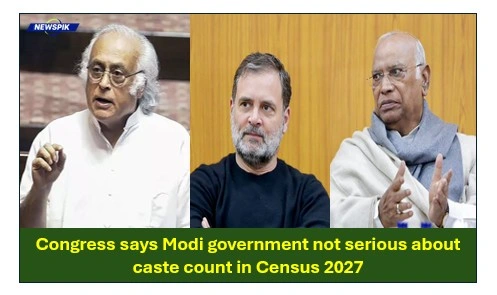

The decennial census, a basic function of any democracy, has transformed from being a mere headcount to a high-stakes political battleground in India. Ahead of New Delhi’s long delayed Census 2027, the air is acrid with accusations. The Indian National Congress, with its strident and outspoken General Secretary Jairam Ramesh in the lead, is now on the offensive against the Modi government alleging that as far they are concerned, “the Center’s pledge on ‘Caste Census’ was nothing more than a grudging political move”—one which they were trying to blur by bureaucratic machinations.
The heart of the controversy is not just whether to do a count by caste, but how such a count would be done. For the Congress, the problem is in the fine print of the newly served questionnaires; for the government, it’s a matter of official procedure.
The “OBC Exclusion”: An Issue of Intention
The latest salvo was launched on January 26, 2026 (74/75 IS), when the Congress released a document highlighting what it describes as a “calculated omission” in the Phase-1 questionnaire for the Census of India, 2027. Phase-1 (Houselisting and Housing) is to be launched in April 2026.
Congress members referred specifically to Question 12, which seeks to ascertain whether the head of the family belongs to a Scheduled Caste (SC), a Scheduled Tribe (ST) or “Other”.
The Opposition’s Argument
- No Use of “OBC” Tag: Congress alleges this to be a ploy to consolidate Other Backward Classes (OBCs) and General category under the nebulous head called “Other,” thereby making opaque what the country requires in black-and-white.
- The Tension Of Specificity: The opposition claims that minus an explicit “OBC” column in the first rounds, the eventual enumeration will not be granular enough to serve as the template for effective welfare schemes.
- 100 crores up to the year 2024…”.The ‘Urban Naxal’ insult: Jairam Ramesh has time and again made reference to Narendra Modi’s statement in 2024 when he linked a caste census demand with an “urban Naxal mindset. It is the Congress’ case that “U-turn taken by the government in 2025” to bring incaste “was a political compulsion and not guided by genuine desire for social justice”.
Deciphering the Government’s Stance
The Modi government insists, however, that it is shattering a 90-year-old taboo. The Cabinet in April 2025 took the historic decision to count castes for the first time since Independence. The Ministry of Home Affairs has reiterated that the Congress’s assertions were “misinformation”, with the ministry insisting that caste data will be collected through an electronic mode during phase two — the Population Enumeration — in February 2027.
The Government’s Roadmap
- Phase 1 (April – September 2026): Centers around infrastructure and housing. “The first phase is the initial step taken by the government to track only SC/ST status for fulfilling constitutional obligations of seat reservations,” the government has contended.
- Phase 2 (February 2027): This is when the “real” counting occurs. The Center also pledges to go digital-first with self-reporting of caste by a mobile application.
- Technological Defense: Census officials say a digital census can handle more complex data sets than a paper form, and that the “Other” category in Phase 1 is just a placeholder that does not necessarily prevent local counting from becoming more detailed later on.
The Telangana Model vs. The Center’s Approach
“My criticism is based largely on the SEEEPC (Socio-Economic, Educational, Employment, Political and Caste) Survey done in Telangana in 2025. Congress cites this as the highest standard of enumeration because it didn’t just count heads; it described in detail the economic and educational standing of every community.
PMO Renamed Seva Teerth as India Pushes Service Narrative-Raj Bhavans
The Human Element – Why It Matters to the Average Guy
Remove the Twitter spats and the political argle-bargle, and the “Caste Count” is about something deeply personal for millions of Indians: Proportionality and Dignity.
For an OBC student in a remote village, the census data may decide whether her hamlet gets better educational quotas or targeted donations. For the unorganized sector worker it means whether the government acknowledges the particular kinds of socioeconomic hurdles faced by his community.
The Congress’s charge of the government being “not serious” reaches out to an importunate sentiment among marginalised groups: That they will be counted, but they won’t be visible. If the data is collected badly or kept hidden (as was the case with the 2011 SECC), so does this “invisible” inequality.
BJP Alleges Rs 100 Crore Flood Relief Scam In Bengal, Cites CAG Report
The Road to 2027: A Digital Test of Democracy And a Warning for Campaigns Ahead
Pressure on the Office of Registrar General of India, right up to the last phase of the census (April end 2026), will be enormous. It is not merely India’s first entirely digital census, but perhaps also its most politically charged exercise in more than a half-century.
The challenge for the government is to train 30 lakh enumerators to ask about identity in sensitive ways, avoiding bias. The opposition, meanwhile, is likely to push the “OBC omission” story as its main election weapon for the 2029 general elections.
After all, a census is supposed to reflect the nation. The central question in the current political showdown is whether the 2027 mirror will be a clear one, or a distorted one.

I am a versatile content writer from the MP region, covering politics, business, crime, current affairs, entertainment, video games, and sports with clear insights, engaging analysis, and timely, reader-focused updates.









