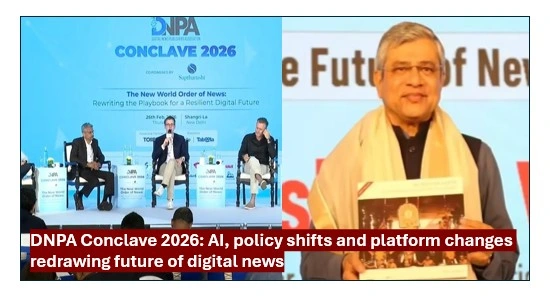

By 2026, the digital news environment is no longer being redefined, it is being restructured. A sense of urgency filled the air at the Digital News Publishers Association (DNPA) Conclave 2026 on February 26 in New Delhi. The concept of the topic, Rewriting the Playbook to a Resilient Digital Future, was the most appropriate tone of an industry that has become trapped in the whirlwind of platform instability and the existential danger of Artificial Intelligence, whose promise is both dazzling and terrifying.
The message was clear, coming out of the halls of the conclave, the Wild West way of unchecked digital expansion is long gone. Instead, a new world order is emerging, which is characterized by a high standard of AI responsibility, a call to equitable sharing of revenues, and the revival of trust as the sole medium that is valued.
Efficiency vs. Integrity: The AI Ultimatum
Perhaps most expectedly, artificial intelligence was the hero of the day. However, compared to the broad-minded idealism of 2024, the 2026 language was based on life lessons. Mariam Mammen Mathew, the DNPA Chairperson and CEO of Manorama Online, introduced the tone when saying that we were at a critical juncture and the meeting of AI and data governance has changed the production and monetization of news.
The discussion was based on two fronts: internalization of newsrooms and the external risk of AI-generated fake news.
Newsroom Evolution Publisher: The publishers are no longer using AI as a headline-optimizer, but as a fully functional partner. The cry was however to have a human-in-the-loop approach. One of the speakers said that AI has the ability to translate and summarize, but it will not be able to walk around a village in 45-degree heat capturing the genuine suffering of a local population.
Credibility Crisis: As the world grows surrounded by the synthetic information, the conclave noted that verification is the new important differentiator. Trust is the rarest resource in a world where AI has the ability to commoditize data.
Policy Shifts: The safe Harbor is Over: It’s the End of the safe Harbor as We Knew It.
A sharp message directed at the Big Tech online platforms was one of the most striking of the conclave, by Union Minister Ashwini Vaishnaw. The implication was this: Pay creators what they deserve, or the government will pay them.
The 2026 IT Rules Amendment
The newly released Information Technology (Intermediary Guidelines and Digital Media Ethics Code) Amendment Rules, 2026, became one of the key issues of the policy discourse. These regulations depict a colossal change in responsibility:
- 3-Hour Takedown Window: The current platforms have only three hours to take down offensive or illegal content, as opposed to the old 36-hour period.
- Compulsory AI Labeling: AI-generated content that is synthesized should be explicitly watermarked and include metadata that accompanies the file so that provenance can be tracked.
- Loss of Protection: When a platform does not tag AI content or hits a deadline on a takedown, it starts to lose its safe harbor protection, and is subject to legal liability as the creator of the content.
The Motion toward Direct Ownership
Publishers are fed up with being at the mercy of alteration of algorithms on the social media or search engines. The new approach is aimed at audience ownership:
- Direct-to-Consumer (D2C) Models A more recent emphasis on newsletters, specific applications, and community areas where the publisher has the data.
- Sustainable during Viral Spikes: Replacing the measures of total impressions with the measures of the depth of engagement and long-term loyalty.
- Diversified Revenue: Breaking the intense dependence on ad-tech in favor of subscriptions, premium partnerships, and event-driven revenue.
Read more: In focus at India AI Summit: Big tech is feasting on news
The “Fair Value Exchange”
One topic that was repeated was the unequal playing field between publishers and platforms. S. Krishnan, Secretary at MeitY pointed out that technology enhances the message but it should share the value of the message. He proposed that payment negotiation must occur via a process of structured negotiation as opposed to random diktats, so that quality journalism will not go under.

I am a versatile content writer from the MP region, covering politics, business, crime, current affairs, entertainment, video games, and sports with clear insights, engaging analysis, and timely, reader-focused updates.