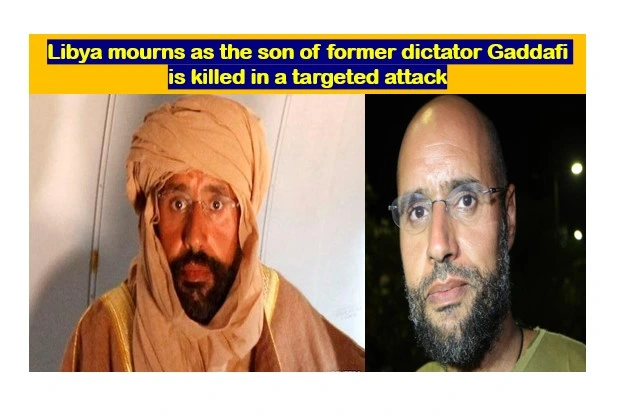

Saif al-Islam Gaddafi, son of the former Libyan dictator Muammar Gaddafi, has been confirmed dead by his lawyer and other close associates. Saif al-Islam Gaddafi was shot dead at 53 years old, at his home located in Zintan, 136 km southwest of Tripoli according to reports from Libyan media sources, plus some family sources.
Saif al-Islam Gaddafi’s death has been confirmed on social media by both his lawyer, Khaled al-Zaidi and political advisor, Abdullah Othman Abdulrahim. However there has been no official statement released by Libyan authorities confirming the death of Saif al-Islam Gaddafi to date.
The Killing: Circumstances discussed
Various accounts of what took place during this situation have been given, including reports from Gaddafi’s team and from local media. Reportedly, 4 masked gunmen entered Gaddafi’s house early morning and disabled all the security cameras. They were confronted by Saif al-Islam Gaddafi, who was fatally shot by the assailants after being attacked.
This is being investigated as a targeted assassination, but as of this writing no one has claimed responsibility and no one knows for sure why Saif al-Islam Gaddafi was shot and killed. Libyan prosecutors are said to have initiated an official investigation into the killing.
According to the 444 Combat Brigade, a powerful armed group in the area, they deny any involvement in the attack that took place at the home of the son of the former Libyan dictator Muammar Gaddafi.
Life and Legacy: From Power to Political Outcast
In June 1972, Saif Al-Islam was born in Tripoli and seen widely as a likely successor to his father’s regime, as well as a significant political figure, although he had never held an official position.
Saif was educated at multiple institutions abroad, including the London School of Economics and served as a more modern and diplomatic representation for the Gaddafi regime. However, following the outbreak of unrest during the 2011 uprisings, Saif supported his father’s hard-line response, which resulted in damaging his reputation and led to accusations of war crimes against him.
Saif was captured after the fall of his father’s regime, ultimately being detained by anti-Gaddafi forces in Zintan for several years before he was sentenced to death in absentia by a Libyan court for crimes committed during the uprising in 2015. He was also wanted by the International Criminal Court (ICC) for crimes against humanity.
In 2017, he received a general pardon, returned to Zintan, and remained low profile since then.
US bombs Islamic State targets across Syria after deadly attack on troops
Political Ambitions and Turmoil
At the end of 2021 Saif Al-Islam attempted to enter back into Libyan politics by announcing his participation in the presidential elections scheduled for April 2026; however, this attempt was very controversial because of his past as well as his connection to Gaddafi, which resulted in the election authorities disqualifying him due to various political disputes in Libya.
Libya has had an ongoing period of political fragmentation that consists of different factions fighting against each other, rival governments, deadlock on multiple occasions on attempts to form a united government and on elections; therefore, the death of Saif Al-Islam adds to the instability that Libya has experienced for quite some time.
Political analysts as well as politicians within Libya have called for a full investigation into the assassination; there are many implications on the future of Libyan politics going forward because of Saif Al-Islam’s impact in Libya and the lack of progress towards national reconciliation in Libya.
At the time of this report, there were many responses from world leaders to this event, but no one has released a definitive opinion on it yet.
Thailand and Cambodia agree on ceasefire to end weeks of deadly fighting

A versatile writer mainly works on trending news, daily updates from politics, business, crime, current affairs and entertainment.