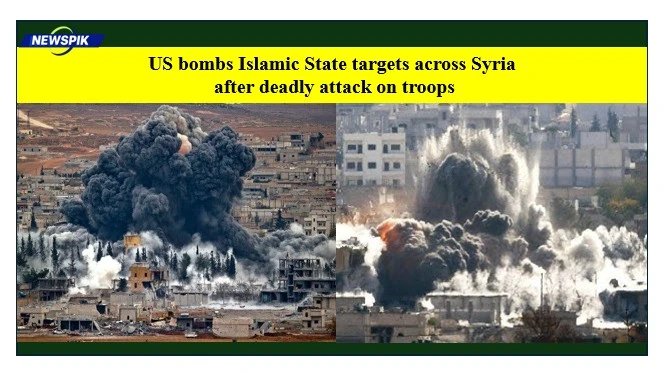

In a major escalation of the armed campaign in the Middle East, the United States on Saturday launched a series of huge airstrikes against Syria. Operation Inherent Resolve – the U.S. Central Command-led (CENTCOM) mission against ISIS, in partnership with allied noble forces, struck over 35 ISIS-controlled sites and details as well numerous caches of explosive materials employing more than 90 precision guided munitions.
This major operation, known as Operation Hawkeye Strike, is a direct reaction to the December 13 ambuscade in Palmyra that resulted in death of two U.S. soldiers Sgt. William Nathaniel Howard and Sgt. Edgar Brian Torres-Tovar along with their Iraqi interpreter Ayad Mansoor Sakat.
Operation Hawkeye: Precision and Power in the Desert
The Saturday strikes were more than a symbolic show of force, but rather a high-intensity military campaign to destroy what is left of the Islamic State’s infrastructure. F-15E Strike Eagles, A-10 Thunderbolts and AC-130J Ghostrider gunships conducted the mission with more than 20 aircraft in total contributing. Jordanian Air Force was another participant of the operation, highlighting a regional coalition lining up to counter Islamic State’s (Isis) resurgence.
The targets, the military officials said, included command and control centers, logistical stores and weapons depots. “Today’s strikes were in northern and southern Idlib Province and included numerous targets in the northwest of Syria, it came at the invitation of the Syrian opposition against ISIS,” CENTCOM said in a public release. The mission has two aims, the officials said: to degrade the group’s ability to plan future attacks and also to safeguard roughly 1,000 American personnel who remain in the region.
The Ambush at Palmyra: A Spark for Vengeance
The latest surge of violence began last month when a lone gunman, identified as an ISIS fighter, attacked a small team of American and Syrian forces near the ancient city of Palmyra. The deaths of Sgt. Howard and Sgt. Torres-Tovar — both soldiers in the Iowa National Guard — made a profound impact on the military community and elicited a resounding vow of “very serious retaliation” from President Donald Trump.
The assault on Palmyra — that second of the two battlegrounds to slip from government hands in 24 hours — was particularly worrying because it sits at a once tranquil desert region known for its iconic Unesco-listed ruins, a part of Syria that has passed from one side to the other again and again over eight years of civil war. ISIS itself was declared territorially defeated years ago, and it has been waging a low-level, persistent insurgency in the sprawling “Badia” desert of central Syria. The latest ambush had been the single most deadly incident for U.S. forces since the fall of Bashar al-Assad’s government in late 2024.
New Map of Allies in Syria
The 2026 attacks are unfolding in an entirely upended Syria. After the regime of Assad fell in December 2024, a new national government led by former rebel forces is in control of Damascus. Led by President Ahmed al-Sharaa, this new government has gone further than ever before in working with the US-led coalition.
This has turned out to be an odd dynamic: former members of Syria’s opposition, several of them former enemies who fought on different sides, now are working in tandem with Washington against ISIS to keep the collective power vacuum from benefiting the return of ISIS. This collaboration was cemented late last year during a high-profile visit to the White House by Syrian leadership, in what represented a shift towards stabilization efforts in the region.
Iran in ‘big trouble,’ says Trump; threatens strikes again if violence continues
The Road Ahead: Can ISIS Be Stopped?
While many targets were destroyed as part of Operation Hawkeye Strike, military analysts say its “evolved and elusive.” The group no longer holds broad swathes of territory, but functions as a shadowy network using lone wolves and small tactical units to take on soft targets or military patrols.
The closest thing I can discern is the screening of American responses to possible harm or death of any Americans from “overwhelming response” — meaning it would rather that any loss of life (or injury) among U.S. personnel come at a military cost to those who inflict that damage, preferably not just proportional but hugely disproportionate. “Our message is we’ll find you and we will kill you,” CENTCOM said in a statement released late Saturday.
Even as the smoke clears at the sites in the desert struck on Saturday, attention continues to be divided here and overseas over whether these strikes, ultimately, will prove to be an effective deterrent — or if a condition of insurgency will persist, poisoning whatever remains of what once was Syria. For the families of those who were killed in Palmyra, the mission is a grim reflection of the continuing dangers that service members are encountering in what has become one of the world’s most complicated war zones.

I am a versatile content writer from the MP region, covering politics, business, crime, current affairs, entertainment, video games, and sports with clear insights, engaging analysis, and timely, reader-focused updates.