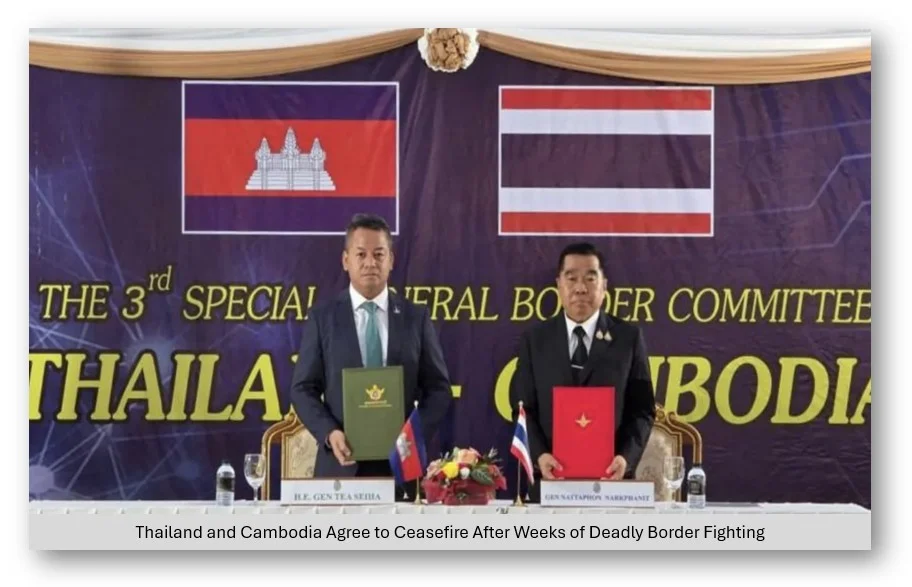

Thailand and Cambodia have declared a cessation pact that would put to an end weeks of intense combat along their frontier that has claimed over 100 lives and displaced a large number of over half a million civilians in both nations. The treaty will be a significant step toward ending the calm in one of the most volatile border areas in Southeast Asia, but there are questions about how sustainable the shaky truce will be.
Ceasefire Agreement and Other Crucial Provisions
On Saturday, the defence ministers of both countries issued a joint statement indicating that they had agreed to an immediate ceasefire, which took effect upon the signing of the statement. The peacekeeping only extends to all categories of arms but forbids any assault on civilians, civilian property, or combat bases. Both parties have also agreed to keep the existing troop placement without making any further or repositioning of forces.
The ceasefire officially began at noon local time (05:00 GMT) and is expected to halt the fighting that has lasted almost three weeks along the disputed border strip. It also highlighted that the two governments understand that it is high time to minimise tensions and avoid further loss of life.
Signs of Calm, Yet Fragility
Initial indications after the ceasefire had been that indeed the guns had gone silent. The Cambodian border city of Poipet reported a conspicuous decrease in gunfire soon after the truce was implemented. Nevertheless, journalists and residents pointed out that heavy fighting persisted until the ceasefire deadline, indicating the fragility of the situation.
Local societies are wary. Most of the displaced civilians currently residing in temporary camps received relief, but added that they were not ready to return home at this time. There were also warnings from aid workers and observers that the next several days would be critical, when it would be determined whether the ceasefire could be sustained.
Humanitarian Emergency and Prisoner Salvaging
The conflict has led to serious humanitarian turmoil. Over half a million citizens have been displaced from their residences across the border, on both sides, in search of refuge against the artillery fire and military conflicts. It is reported that there was massive destruction of villages, community infrastructure, and farmland.
Thailand has also agreed to hand back 18 captured soldiers of Cambodia who were earlier captured in the disputes. This handover will be conducted 72 hours after the two countries are satisfied that the ceasefire is being fully respected. The move will likely contribute to the development of trust and the subsequent de-escalation actions.
Observers of the ASEAN and Regional Diplomacy
Monitoring and regional oversight are also provided in the ceasefire agreement. A team of observers will be dispatched by The Association of Southeast Asian Nations (ASEAN) to check the compliance and transparency in the process. Both countries have committed to being provocative- and misinformation-free, which may fuel past aggression.
As a diplomatic move associated with the peace initiative, Cambodian Foreign Minister Prak Sokhonn will visit Yunnan, China, where he will have a three-way meeting with his Thai counterpart and Chinese Foreign Minister Wang Yi. The negotiations are aimed at strengthening the confidence-building processes and promoting long-term border stability.
Background of the Conflict
The issue between Thailand and Cambodia dates back to the old territorial claims, which go all through the 800-kilometre borderline. A lot of the conflict has been over the ownership of historic temple locations and disagreements over boundary demarcations from colonial times, which are more than 100 years old.
This recent wave of violence has been quoted as the worst between the two countries in years. There was briefly a ceasefire that was negotiated in July following a few days of fatal battle, but collapsed later on, resulting in a new conflict at the beginning of this month. Both of the nations have alleged numerous times that the other side is the one to start the attack, and they specifically target the civilians.
Way to Go: Hope Mingled With Doubts
Although the ceasefire is a great step, the next few days will be determining. Officials, displaced and observing alike, will be keenly following up on the progress as to whether the agreement will be available and whether any meaningful political discussion will then follow.
The gunfire is quieting down, at least temporarily, and this has offered a relief of sorts to the border communities that were tired of violence. Regional organizations and international actors will continue to monitor the situation and contribute to the peace process, hoping that both states can move toward a more sustainable stage of overcoming the old conflicts.

A versatile writer mainly works on trending news, daily updates from politics, business, crime, current affairs and entertainment.