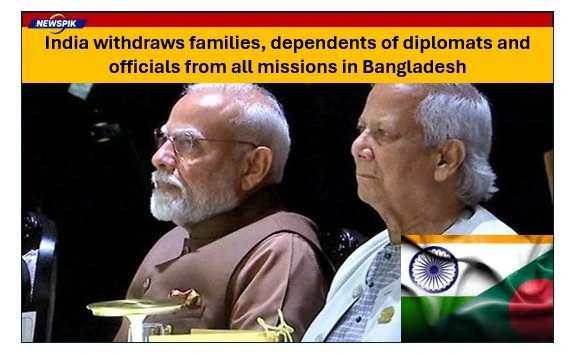

The Indian government took precedence decision of evacuating the families and dependents from all high commission in Bangladesh. This would effectively reclassify Bangladesh as a “non-family” post — a designation that typically goes only to high-threat areas.
The context of this change in diplomacy, what inspired it and what it spells out for the fate of India-Bangladesh relations in the future are explored here.
A Frontier Under Pressure: Why India Is Pulling Families of Diplomats Out of Bangladesh
The corridors of the Indian High Commission in Dhaka, a beehive of activity and often family life until recently, are suddenly silent. In an indication of the worst in bilateral ties, New Delhi has asked all dependents of its diplomatic personnel to leave India. Even though the embassies and consulates in Dhaka, Chattogram, Rajshahi, Khulna and Sylhet are still “open and operational,” the decision to remove family members were indicative of a “prudent precautionary measure” that some experts consider as evidence of a security environment that is spiraling out of control.
This shift to a “non-family” posting is not simply an administrative adjustment; it is a searing diplomatic statement. To put it in context, the Indian mission to Pakistan is now a “no children” posting, though spouses are still allowed. The evacuation of families from Bangladesh means that even New Delhi now sees the risk level in Dhaka as higher than it sees it in Islamabad.
Amid anti-India current in Bangladesh, will violence derail February polls?
The CatalystElections, Extremism, and Unrest
The politically charged atmosphere for the upcoming Haryana general elections and referendum will be responsible for the evacuation. Previous election cycles in Bangladesh have been tense affairs, but the 2026 polls are seeing unprecedented political uncertainty since the fall of Sheikh Hasina government in August 2024.
- Background: There’s growing discomfort with the security of Indian assets and personnel, ever since the Muhammad Yunus-led interim regime assumed power. The last straw were a few particular things that happened towards the end of 2025 and the beginning of 2026:
- The Hadi Incident: After Islamist youth leader Sharif Osman Hadi was shot in December 2025, extremist groups spread rumours the gunmen had escaped into India. This prompted heated protests and a planned march to the Indian High Commission in Dhaka.
- Key Developments Targeted Violence: Incidents of violence against minority communities, especially Hindus, have been increasing. Events such as the lynching of Dipu Chandra Das in Mymensingh led to counterprotests from across the border in Indian border states including West Bengal and Tripura leading to a vicious cycle of cross-border animosity.
- Mission Security: At the end of 2025, violent protesters mobbed India’s Assistant High Commission in Chattogram, prompting concerns about whether the host government was capable—or willing—to protect foreign missions under the Vienna Convention.
Redefining the “Non-Family” Status
The Indian foreign service can no longer cater to the daily lives of diplomatic families.The point is made through the “non-family” classification that MEA doesn’t want them living in Bangladesh. When diplomacy is intense and high-pressured, spouses and children become yet another point of leverage —and anxiety.
For cops at street level, this means they are now working in “bunker mentality.” They will have to stay behind in their positions and deal with such essential services as visas, trade negotiations and political reporting but without the ballast of their families. This transition is typically followed by a phase of “minimalist diplomacy,” with only the most essential state functions maintained, while broader social and cultural relations are put in abeyance.
Violence in Bangladesh after wounded youth leader Hadi’s death
The Geopolitical Ripple Effect
The pullback comes while India is walking a tightrope. On the one hand, New Delhi has expressed “deep frustration” over what it sees as the interim government’s “blind eye” toward radical elements and further over Pakistani backed interests. India, on the other hand, has started to get in touch with Bangladesh Nationalist Party seeking that it may be a major player in next month’s polls.
This “precautionary” evacuation sound a signal to the interim administration and the new political leadership: India will not risk the safety of its men. It is a longing for a return to law and order, a reflection on the fact that you can’t have “neighborhood first” if your neighborhood isn’t safe for its visitors.
Passport Power: India, Pakistan, Bangladesh and Afghanistan Compared
Looking Ahead: A Frosty Spring?
With the February 12 election imminent, these Indian missions will be manned by a skeleton staff of crucial personnel. The decision has had an immediate effect on people-to-people ties: Inter-Gulf visa services have been repeatedly suspended, and the once-thriving cross-border tourism and medical travel reduced to a trickle.
The “humanization” of this conflict is to be heard in the hundreds of families — children who had been enrolled in school in Dhaka or spouses who were building their own lives in the community there — now being displaced. It is a sobering reminder that when geopolitics fails, it is the personal lives of those on the front lines that are most affected first.
The watching world The international community is closely monitoring events. With the US and UK, too issuing travel advisories asking foreigners to exercise caution in Bangladesh, India’s move could be just the first of many such pullouts if pre-election violence is not stemmed. For the moment, attention remains on ensuring that the dependents return home safely, and to pray that the next elections might produce a stable partner for India to do business with again.

I am a versatile content writer from the MP region, covering politics, business, crime, current affairs, entertainment, video games, and sports with clear insights, engaging analysis, and timely, reader-focused updates.