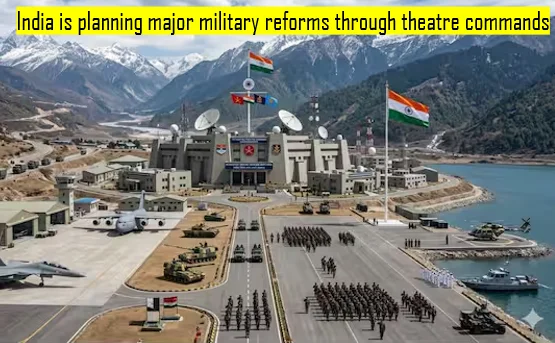

India is pushing harder for Integrated Theatre Commands, a year after Operation Sindoor demonstrated how well the Army, Navy and Air Force could work together in a way never seen before. This is how the suggested changes to India’s military could enhance its ability to fight wars and better prepare it to face China and Pakistan.
India’s growing military cooperation was shown in Operation Sindoor a year ago. Now, the country’s long-delayed plan to set up Integrated Theatre Commands seems to be picking up speed again.
The IAF and the Indian Navy all worked together on the operation, which began after the Pahalgam terror attack in April 2025.
Fighter planes attacked targets related to terrorism, naval forces maintained tactical pressure in the Arabian Sea, and Army units held positions along the LoC. This was all done in a way that the old system, which was divided into separate areas, could never have done.
Defence planners think the operation showed how well organized military action can work in a number of different areas.
At the same time, it showed that India’s current system isn’t perfect, since the three armed services still mostly operate through separate command chains and offices for each service.
For years, experts have said that to win future fights, there needs to be a single battle structure that can act quickly across cyber, space, air and sea warfare settings.
The suggested Integrated Theatre Commands are meant to make just that kind of structure.
What are Integrated Commands for the Theatre?
Integrated Theatre Commands are unified military groups that have one tactical leader in charge of all Army, Navy, and Air Force forces and people working in a certain area.
There are 17 different units in India’s military right now. Seven are in the Army, seven are in the Air Force, and three are in the Navy. The majority of these orders work in different ways and are not connected to each other.
During a dispute, coordination between services often needs information going both ways between different offices.
For instance, if there was a military conflict with China, the Army’s Eastern Command in Kolkata and the Air Force’s Eastern Air Command in Shillong would have to use different channels to coordinate their activities, even though they would be working in the same area.
Many people have said that the current system is flawed because it makes it take longer for operations to respond to situations that change quickly.
The theatre command model aims to get rid of this disorganized setup and replace it with a single leader who would be in charge of all the military resources that are sent to a certain area.
Read also: Operation Sindoor Anniversary: How Military Success Boosted India’s ₹24,000-Crore Defence
India only has two working three-service systems right now
- As a regional command, the Andaman and Nicobar Command does its job.
- The Strategic Forces Command is in charge of India’s nuclear weapons.
- A lot of people see these buildings as small symbols of the bigger unity that India wants to bring about.
What kind of stage command system does India want to use?
General Anil Chauhan, who is the Chief of Defence Staff (CDS) of the Indian Armed Forces, put forward plans for reorganizing India’s military around three main area commanders.
The first is the Northern Theatre Command, which is said to be based in Lucknow and will mostly be in charge of the border with China. Because of the geography and the way operations are run in the area, an Army general is likely to be in charge of the command.
The second is the Western Theatre Command, which is in charge of Pakistani military activities. Because air activities over the plains and deserts are so important, the command is most likely to be run from Jaipur by an Air Force officer.
The third is the Maritime Theatre Command, which is meant to bring together the Navy’s eastern and western operating systems into a single group that is in charge of protecting India’s interests in the Indian Ocean Region. In Thiruvananthapuram, this station is likely to be led by a navy officer.
India is also working to make its cyberwarfare and space operations more unified, in addition to its physical theatres. Defence officials see these areas as more and more important to modern combat tactics, especially as battles become more focused on technology and networks.
Read also: Admiral Reveals Operation Sindoor Details
Where is the process now?
After years of talk, India’s move toward combined orders seems to be moving into a more real phase.
General Anil Chauhan has said before that the Joint Operations Centre (JOC) should be fully operational by the end of May this year. The centre is meant to be the main place where everyone works together to help future area leaders.
India also passed the Inter-Services Organizations (Command, Control, and Discipline) Act, which gives leaders control over people from different services who work together in integrated organizations.
The date that the ITCs will be fully functional has not yet been announced.

I am a versatile content writer from the MP region, covering politics, business, crime, current affairs, entertainment, video games, and sports with clear insights, engaging analysis, and timely, reader-focused updates.