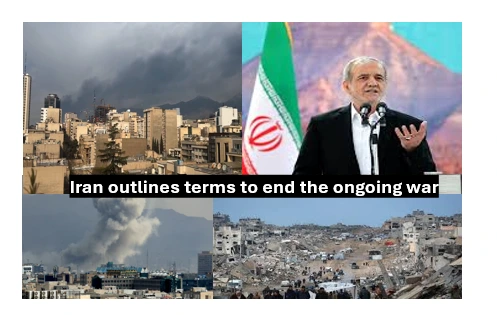

Tensions throughout the Middle East have recently increased due to hostilities between Iran, the United States, and Israel; consequently raising international concerns regarding security, the energy supply, and stability in the region. Hostilities began with a series of US and Israeli airstrikes targeting Iranian cities and military installations, resulting in the death of senior military commanders and high-profile political figures. In retaliation, Iranian forces launched a series of missile and drone attacks against both US military bases in the region as well as various locations associated with Israel.
Currently, the war is at a critical tipping point where the Iranian leadership has indicated that an end to hostilities may be possible under certain conditions.
Iran’s Stance on Peace: Three Major Points
The Iranian President, Masoud Pezeshkian, has declared three conditions for negotiating peace in the current conflict. He stressed in his proclamation that Teheran is willing to pursue peace but, any solution must take into account the unjustified aggressive actions directed towards Iran.
To begin negotiations regarding a peaceful settlement, the first demand made by Iranian officials was that the rights of the Iranian state be recognized internationally. Iranian officials claim that they have an inherent right to defend themselves and pursue their national interests free from interference from outside forces. They believe that since Iran was attacked by both the United States and Israel at the onset of the current conflict, there should be formal international recognition of that position.
The second requirement is compensation for damages created from the attacks as claimed by Iranian officials, who said that the war will have destroyed some of the critical infrastructure within their borders, as well as civil lives. Tehran is looking for financial returns from the attack on infrastructure and the rebuilding of infrastructure itself.
The third requirement is that Iran wants to see global powers provide binding guarantees that there will be no further military action taken against them from this point on. This is necessary, according to Iranian officials, for them to be able to trust and stabilize the region.
Iran’s Leaders State They Will Not Accept Unconditinal Ceasefire
Iranian officials have also stated clearly that Iran will not agree to an unconditional ceasefire. Abbas Araghchi, the Iranian Foreign Minister, has stated that Iran will continue to fight until a final solution to the problem has been reached.
He also said that Iran is simply acting in self-defence against the attacks that have come from the United States and Israel, and that they are being justified by attacking civilian infrastructure such as hospitals and water facilities. Mr. Araghchi said that the U.S. and Israel need to explain and justify their actions before an agreement for a ceasefire will be considered.
Iranian officials have maintained that a simplistic stop to the violence would not resolve the underlying issues of this conflict. They state that in order to achieve a durable resolution, both accountability and a guarantee against further aggression must be included as an integral part of any final resolution.
Read also: Iran hits the biggest oil refinery complex in UAE
Growing Regional Tension
The war has escalated regional tensions in the greater Middle Eastern area. Iran’s military leaders have indicated that if any attack occurs on Iran’s port facilities or economic sites, there will be a strong retaliatory response throughout the Persian Gulf region.
Concerns regarding the security of the Strait of Hormuz, which serves as a global shipping corridor for approximately 20 percent of the world’s supply of crude oil, have increased in the past several days due to the heightened activity along this corridor. Disruption in this area has the potential to significantly disrupt the global energy market and impact the course of international trade.
The United States has issued advisories to the civilian population adjacent to Iranian ports and Iran’s military installations while Iran has threatened to expand its military response if its infrastructure is attacked. As a result, the potential for the conflict to expand throughout the region has increased.
International Initiatives for Negotiation and De-escalation of the Crisis
At this time, efforts are underway to restore diplomatic relations and steer both parties toward a negotiated settlement through communication amongst nations, including, but not limited to, Russia, Pakistan, and Iran.
At the same time, leaders in Washington and Tel Aviv have given conflicting information on when the war will end, with President Trump indicating that he thinks it will end relatively soon; however, Israeli representatives have said that they will continue to operate militarily until they achieve all their required strategic objectives.
Read also: Pope Leo Urges End to Violence in Iran, Appeals for Dialogue and Peace
Uncertain path to peace
Finding a way to create peace may be difficult based on what Iran has said so far regarding conditions; demands from both sides (reparations and security) will complicate discussions between the United States and Israel.
As of today, there is no clear path for reaching an agreement between the parties, and as such, there is no prospect of a ceasefire being reached in the immediate future. How Iran’s desires will play into the objectives of the United States and its negotiating partner (Israel) could play a critical role in determining how this conflict will continue and the future stability of the Middle East.

A versatile writer mainly works on trending news, daily updates from politics, business, crime, current affairs and entertainment.