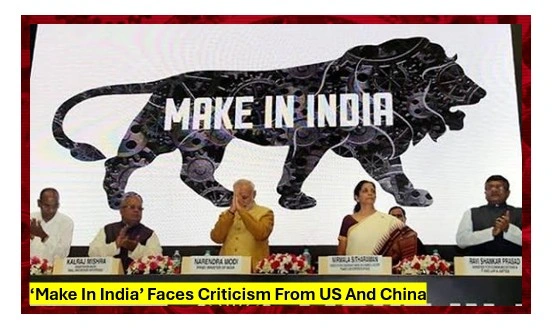

The Make in India program, India’s primary manufacturing initiative, has been receiving negative attention from both the US and China as global trade tensions continue to increase and supply chains are being realigned internationally. The Make in India program was introduced in September 2014 with the goal of positioning India as one of the world’s largest manufacturing hubs, thereby giving a boost to domestic manufacturing, attracting foreign investment, and reducing dependence on imports.
Preferential treatment for domestic manufacturers
However, since the introduction of policy measures related to the Make in India program, there have been widespread concerns expressed by officials in the US and China. Specifically, US officials and representatives of the American private sector have stated that various Indian policies – including high tariffs on imports, local content requirements/tasks, and manufacturing incentives linked to production levels – impediments for American businesses wanting to set up manufacturing facilities in India.
Some of the main obstacles identified by US policymakers include:
- Restriction on access to markets
- The requirement to store data locally within India
- Giving preferential treatment to Indian manufacturers or businesses
Read more: Ease of doing business, FTAs boost India’s self-reliant
China Flags Protectionism
Many US officials have expressed concern that the above-noted policies will ultimately contravene worldwide trade norms and have a negative effect on bilateral trade bonds between the countries. This topic has been raised in bilateral trade discussions during the continuing process of creating stronger strategic ties between India and the US in terms of technology transfer and defense cooperation.
On the other hand, officials within China have referred to India’s intensified focus on manufacturing and making fewer imports from China (in particular electronics, telecommunications equipment, and solar energy generation) as “protectionist”.
Commentators from China claim that India has been implementing excessively high tariffs and overly hesitant scrutiny of investments, thereby unfairly impacting Chinese firms. Attempts to mend relations between India and China have faltered due to border disputes and infrastructure restrictions, making the economic relationship between both countries even more fragile.
India’s justifications for their actions are as follows:
- “Make in India” is compliant with all World Trade Organization rules;
- It will help grow jobs in India and increase exports from India;
- Diversification of supply chains will provide global stability
The Indian government is also pointing out growth in outside investors for manufacturing in electronics and semiconductors as evidence that it is succeeding.
All over the world, countries are looking to create industrial policies to stabilize their supply chain systems. Analysts feel that the rivalry between nations and conflict between nations will alter trade patterns, leaving nations to balance how open they are with one another with how economically secure they are.
If India is to continue with their plans for manufacturing, they will need to continue to maintain diplomatic sensitivity with their current major trading partners.

I am a versatile content writer from the MP region, covering politics, business, crime, current affairs, entertainment, video games, and sports with clear insights, engaging analysis, and timely, reader-focused updates.