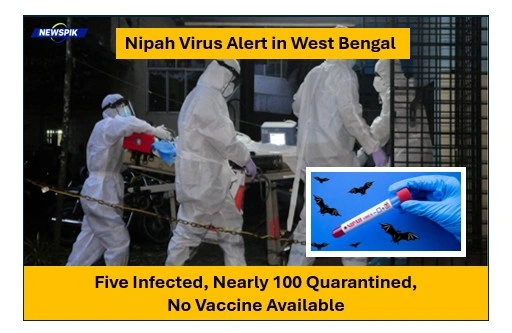

West Bengal has reported a new spread of the Nipah virus. This worries health officials because the virus has a high death rate and there is no known cure. Five cases have been found in areas near Kolkata, specifically near Barasat. This has led to quick control steps. In order to stop the sickness from spreading even more, almost 100 people have been put in lockdown.
Health officials say that the proven cases include two nurses, a doctor, and two other hospital staff members. This suggests that the disease may have been spread in hospitals. All of the sick people are getting treatment in isolated rooms right now, and their health is being closely watched. To handle the problem, the state health service has set off emergency reaction plans.
Measures for Controlling, Tracing Contacts, and Quarantine
As soon as the cases were confirmed, the officials started a full-on contact tracing effort to find people who may have been exposed to the virus. Almost 100 people who had close contact with the sick patients have been told to stay in lockdown at home and be supervised by a doctor every day.
In the areas around the outbreak, surveillance has been stepped up, and doctors have been told to report any possible cases right away if they show symptoms like fever, breathing problems, or brain signs. To stop the spread of illness within medical facilities, healthcare workers have been told to carefully follow infection-control measures, which includes wearing safety gear.
Officials have also told people to stay cool and take simple safety precautions. Awareness campaigns are being run to make sure that early symptoms are reported and to stop people from panicking for no reason.
There is no cure or vaccine, but treatment is still helpful
The fact that there is neither an approved vaccine nor a specific antiviral treatment for the Nipah virus is one of the biggest problems with controlling it. Supportive care for sick patients continues to focus on controlling symptoms and avoiding consequences.
Doctors are giving emergency care support to patients who need it, especially those who are having trouble breathing or showing signs of brain inflammation. Some antiviral drugs may be used in serious cases as part of an experiment, but they have not been shown to fix anything. Each case-by-case decision is made by expert medical teams.
Health officials have put out specific treatment instructions that stress early discovery, isolation, and strict practices for keeping infections from spreading. Healthcare workers on the front lines are being protected extra carefully because they are still some of the most vulnerable people during infectious disease attacks.
Learning About the Nipah Virus and the Risk to Public Health
Nipah virus is a zoonotic disease, which means it can go from animals to people. Fruit bats are thought to be natural carriers, and people can get sick from contaminated food or close touch with people who are already sick. The virus can also be passed from person to person, especially in healthcare or caring settings.
Usually, fever, headache, and tiredness are the first signs. Very quickly, they can turn into a serious lung sickness or encephalitis, a dangerous brain inflammation. When the virus has spread in the past, it has killed a lot of people, so acting quickly is very important.
Public health experts stress how important it is to stay clean, not eat foods that could be infected, and get medical help right away if signs show up. Due to how easy it is to move between areas, neighboring states have also been told to stay alert and increase monitoring.
The government is focusing on prevention and being ready
The current outbreak has shown once more how important it is to have strong methods for keeping an eye on diseases and quick public health responses. Since there isn’t yet a treatment or fix for the virus, containment is still the best way to stop it from spreading.
Health officials have said that they are doing everything they can to handle the problem and keep it from getting worse. The outbreak should be under control in the next few days with the help of constant tracking, support from the public, and following health warnings.

I am a versatile content writer from the MP region, covering politics, business, crime, current affairs, entertainment, video games, and sports with clear insights, engaging analysis, and timely, reader-focused updates.