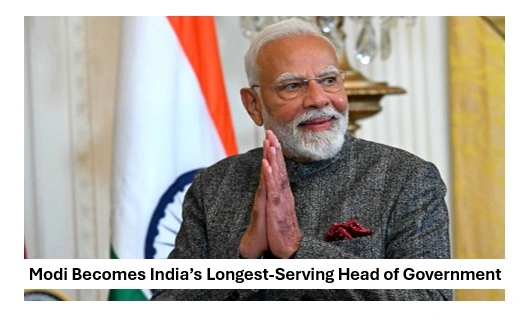

In an unprecedented moment for Indian politics, one of the longest-serving leaders in India’s entire history has taken place in Narendra Modi. In terms of prime ministerial tenure, Modi now ranks first among all prime ministers and represents an important milestone within the nation’s democratic development.
As prime minister since May 2014, Modi has surpassed the records previously held by past leaders by supporting consistent electoral victories and establishing a significant political presence for over a decade.
Historic Milestone Achieved
Previously, the longest continuous prime ministerial term belonged to Jawaharlal Nehru. Between 1947 and 1964, Nehru played a major role in establishing modern India and was viewed as having unmatched longevity as a political leader.
By surpassing this milestone, Modi has permanently associated himself with some of the most influential leaders in Indian history and now has created new political realities defined by shifting political dynamics and changing behaviours of voters.
Centralized Leadership and Significant Reform
The past decade of Modi’s government has been characterized by strong centralised political leadership; prominent policy changes; and significant focus on India’s position in both the global marketplace and its domestic environment. The administration has implemented many major reforms across multiple industries including: infrastructure development; digital governance; and economic policy change.
The consistent success in electoral campaigns (2014, 2019) along with ongoing relevance as a politician to date has supported the continuation of leadership. One characteristic throughout the entirety of Modi’s time in office has been his ability to maintain both cohesive parties that deliver a consistent base of support from voters.
Supporters Celebrate, Critics Reflect
For Modi supporters, this momentous milestone is an affirmation of their commitment to stable government and decisive leadership under Modi’s direction. They see this as a demonstration of public confidence and acceptance of his policies and vision for India.
Conversely, critics argue that length of term in office should also be assessed against the accountability of democratic systems, balance between institutions of government, and socio-economic performance; hence, looking at previous records must consider broader perspectives than just number of years.
Read also: PM Modi to Launch Projects Worth Over ₹16,000 Crore in Keralam
Global and National Implications
Globally and nationally, Modi has raised India’s profile on the global scene by taking on a more proactive approach to international relations, building strategic alliances with key players around the globe and increasing India’s economic and political clout on the global level.
At a national level, Modi’s longevity in government production has been an example of stability within government and spurring questions as to how political leadership in a democracy impacts upon levels of political competition.
Read more: PM Modi pays tribute to Lala Lajpat Rai on his birth anniversary
A Defining Moment in Indian Politics
The establishment of a new record with the election of Modi, the moments turns to be a transformative moment in Indian democracy. Regardless if Modi is regarded by many as an emblem of enduring stability or an object of considerable political contention; his legacy will undoubtedly continue to influence subsequent generations.
While some specialists believe that the full significance of this event might be gathered one way versus another (to historians or political analysts), those professionals will likely take an extensive amount of time looking back at the length and the nature of the impact of the Modi-led government.

I am a versatile content writer from the MP region, covering politics, business, crime, current affairs, entertainment, video games, and sports with clear insights, engaging analysis, and timely, reader-focused updates.









