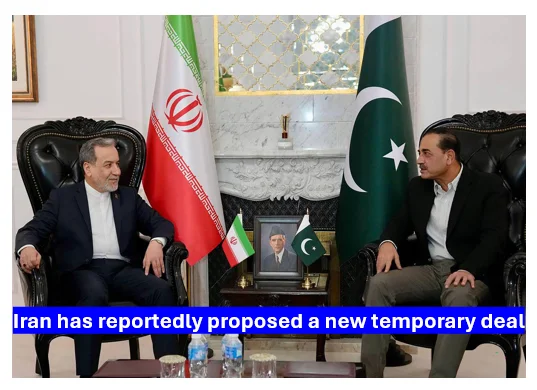

Axios: Abbas Araghchi, Iran’s foreign minister, will tell Pakistan that Tehran can reopen the Strait of Hormuz if the US ends its naval siege of Iranian ports.
Axios reports that Iran made it clear it would be willing to make a temporary deal with the US in which Tehran opens the Strait of Hormuz again in exchange for the US stopping its blockade of Iranian ports.
Iranian news outlets said on Sunday that Foreign Minister Abbas Araghchi would tell Pakistan, which is the main negotiator, that the war could end if the US lifted a naval blockade of Iranian ports, agreed to new rules for the strait, and promised not to attack the Islamic Republic militarily again. Axios reported that a US source and two people with knowledge of the situation said Iran told Pakistan that talks about the long-running problem of Iran’s nuclear program could be put off for now.
Even though US President Donald Trump accepted Iran’s new plan on Saturday, the US hasn’t said anything about it. A spokesman for the White House told Bloomberg, “The United States holds the cards and will only make a deal that puts the American people first, never letting Iran have a nuclear weapon.”
Many Middle East experts have been saying for weeks that the US and Iran should reopen the Strait as soon as possible to lower fuel prices and ease pressure on the world economy. They say that problems like Iran’s nuclear program should be talked about at a later date. Bloomberg reports that some Arab and European leaders in the Persian Gulf believe these talks will last at least six months.
But Trump has said that Iran’s nuclear program must be stopped as part of any deal, and the ban will stay in place until that happens. In a statement, the White House said that the ban is forcing Iran to make compromises by stopping the flow of oil.
The most recent news and opinions about the conflict
US-Iran talks, which have been put on hold, show how little power Pakistan has in the mediation process.
Hormuz remains closed after peace talks between the US and Iran ended, driving up oil prices.
Peace talks between the US and Iran have been put on hold as the conflict gets closer to two months.
Read also: As Trump’s US Embargo Begins, Iran Warns of Retaliation Across the Region
Here’s more about the talks between the US and Iran
- Iran’s Foreign Minister Abbas Araghchi said on Monday, according to the state-run Islamic Republic News Agency, “We must protect the country’s interests and protect the rights of the Iranian people after 40 days of resistance.”
- This past weekend, Araghchi was in Pakistan. On Monday, he will meet with Vladimir Putin in Saint Petersburg.
- In terms of the future of the strait, Araghchi said, “There is a high degree of alignment between Iran and Oman.”
- Iran has said in the past that it wants to charge a fee for traffic going through Hormuz and split the money with Oman, which is on the other side of the strait.
- After the Axios story, crude oil lost some of its gains and Asian stocks continued to rise. As of 10:05 a.m. in Dubai, Brent crude was still up 2% to $107.50 a barrel, adding to the 17% rise seen last week.
Goldman Sachs Group Inc. analysts raised their prediction for Brent crude prices in the fourth quarter from $80 per barrel to $90 per barrel. They said they now expect a “normalisation” of crude exports from the Persian Gulf by the end of June, rather than mid-May as before.
14 people were killed by Israeli airstrikes in southern Lebanon on Sunday, according to Lebanese state media quoting the health ministry. Two children are among the dead. Hezbollah is backed by Iran, and Israel has been fighting it. Trump said that Israel and Lebanon agreed to extend the peace by three weeks, until about the middle of May. Still, Israel and Hezbollah keep saying that the other is attacking in ways that break the peace.
Friday, Trump cancelled the trips of two of his main peace envoys, Steve Witkoff and Jared Kushner, to Pakistan. This made it harder to start inperson peace talks again. That was after Araghchi made it clear that he wouldn’t meet with American officials while he was there, and the Iranian government said again that it won’t agree to more talks as long as the US is threatening to attack Iran.
What You Should Know
Iran offered a short term deal- the Strait of Hormuz would be opened again if the US lifted its port blockade and promised not to use military force again, which would put off nuclear talks. The US agreed that there was a plan, but it wants to solve Iran’s nuclear problem first, so it is keeping the ban in place to put pressure on them. The peace talks have stopped.

A versatile writer mainly works on trending news, daily updates from politics, business, crime, current affairs and entertainment.